Building a fort isn’t just play—it’s a hands-on way for children to explore engineering, geometry, teamwork, and problem-solving. The following selection of fort-building kits offers a range of rod-and-ball systems that snap together quickly, inspire imaginative play, and scale from simple tents to complex multi-room structures. Each option is suitable for indoor or outdoor use, and many include storage solutions to keep play areas tidy.
| Product | Brand | Pieces | Age Range | Play Styles |
|---|---|---|---|---|
| V-Opitos 180 Pack Fort Building Kit | V-Opitos | 180 pcs | 4+ | Castles, Tunnels, Play Tents |
| Fort Building Kit for Kids, 140 Pcs | SpringFlower | 140 pcs | 4-12 | Caves, Tunnels, Castles |
| FUNbelievable! 132 Piece Fort Kit | FUNbelievable! | 132 pcs | 4+ | Tents, Hideouts, Castles |
| Tiny Land Fort Building Kit (Non-glow) | Tiny Land | 130 pcs | 5-12 | Indoor & Outdoor Forts |
| OBUBY Kids Fort Building Kit | OBUBY | 120 pcs | 3+ | Caves, Tents, Castles |
The following five picks stand out for a mix of components, ease of use, and imagination-enhancing features. They provide sturdy connectors, varied angles, and clear guidance to help kids build increasingly complex fort designs while developing spatial reasoning and teamwork.
V-Opitos 180 Pack Fort Building Kit

The V-Opitos kit includes a comprehensive mix of 100 long rods, 35 connector balls, and multiple channel connectors (6, 5, 4, and 3 channels) plus 2-channel pieces. This arrangement supports large, multi-room forts and extended tunnels. The system emphasizes STEM learning by enabling children to discuss 3D shapes as they assemble: rods as edges and connectors as vertices, fostering geometric thinking and problem-solving during construction. A step-by-step guide helps kids translate ideas into tangible models, encouraging persistence and planning alongside creativity.
Fort Building Kit for Kids (140 Pcs)

This SpringFlower kit provides 64 long rods, 46 extend connectors, and 30 magic balls, totaling 140 pieces. The system is designed for quick assembly and disassembly, with an emphasis on stability—forts are built to stay intact during play. It supports a wide array of structures from caves to teepees and playhouses. The design encourages collaborative building, as children coordinate to transform a shared space into a multi-room hideaway, all while developing spatial reasoning and teamwork.
FUNbelievable! 132 Piece Fort Kit

The 132-piece set from FUNbelievable! features 88 connecting sticks and 44 connector balls. The pieces snap together to form a wide array of structures—forts, tunnels, castles, and hideouts—that can be rearranged quickly as kids’ ideas evolve. Quick assembly and easy disassembly are highlighted, enabling rapid prototyping of new designs. The kit’s versatility supports creative storytelling and practical problem-solving as children adapt designs to fit blankets, sheets, or lights to create cozy play spaces.
Tiny Land Fort Building Kit (Non-Glow)

The Tiny Land 130-piece set includes 86 rods and 44 balls, with a storage bag for easy cleanup. It’s designed for simple assembly and durability, letting kids build caves, tunnels, tents, rockets, houses, and more. The kit is well-suited for family play sessions, encouraging cooperation and planning as children contribute ideas and adapt structures to fit space and blankets. The storage bag makes it practical for indoor and outdoor use, promoting ongoing engagement with engineering challenges.
OBUBY Kids Fort Building Kit (120 Pcs)
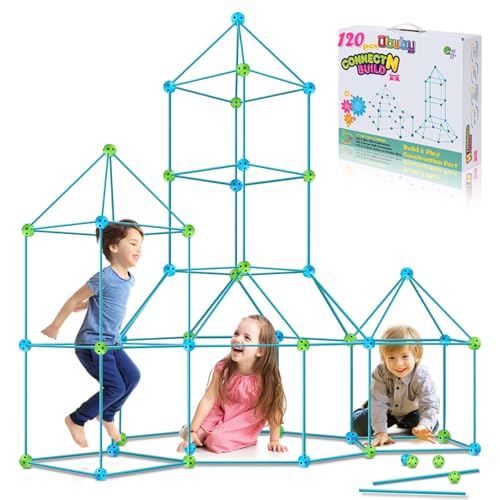
OBUBY’s 120-piece fort kit emphasizes easy assembly with 75 sticks and 23 blue plus 22 green solid balls. The design supports a wide range of structures such as caves, play tents, towers, and pirate ships. Durability and simplicity are highlighted, with a twist-and-connect mechanism that makes setup quick and disassembly straightforward. A storage bag adds portability for indoor and outdoor adventures, enabling families to relocate forts without fuss.
Buying Guide
Key purchase considerations help families choose the best fort-building kit for their space and goals:
- Number and variety of pieces: More rods and connectors enable larger, more complex forts but require more space for storage. Look for sets with a mix of connector types to support diverse geometries.
- Durability and material quality: Plastic components should be sturdy and resistant to bending or cracking. Smooth edges reduce the risk of scratches during play.
- Ease of assembly: Systems with intuitive snaps or socket connections help kids build quickly and gain confidence. Step-by-step guides or online tutorials can accelerate learning.
- Age guidance and safety: Ensure pieces are sized appropriately for the child’s age to minimize choking hazards and to promote safe play with supervision when needed.
- Indoor vs outdoor use: Some sets weather well, while others are best kept indoors to preserve color and integrity. Storage bags or containers are helpful for portability.
- STEM development: Look for kits that encourage geometry, problem-solving, and teamwork. Some sets emphasize 3D shapes, spatial reasoning, and basic engineering concepts.
- Expandability: If you anticipate future growth, choose a system compatible with additional expansion sets to grow with the child’s skills and imagination.
- Storage and portability: A included bag or bin makes clean-up faster and keeps pieces organized for next play sessions.
Choosing a fort-building kit involves balancing the desire for expansive, creative play with practical considerations like space, durability, and age appropriateness. The five selections above provide varied scales and features, ensuring options for different households, play styles, and learning goals.