The following building kits are selected for teens who enjoy hands-on learning, engineering challenges, and creative problem solving. Each kit offers practical activities that explore mechanics, electronics, and design, helping students build practical intuition while staying within safe, self-guided projects. The list covers a range of themes—from historical models to solar-powered robotics and hydro-mechanics—so teens can explore different STEM domains and find their passion in construction and experimentation.
| Product | Brand | Key Focus |
|---|---|---|
| NATIONAL GEOGRAPHIC Da Vinci Catapult Kit | Blue Marble | Historical engineering, functional catapults |
| Discovery Model Engine Kit | Discovery | 4-cylinder engine mechanics, moving pistons |
| Sillbird 12-in-1 Solar Robot Kit | Sillbird | Solar power, outdoor robotics, renewable energy |
| ELEGOO UNO R3 Smart Robot Car Kit | ELEGOO | Arduino-compatible robotics, programming |
| INSOON Mechanical Shark Building Set | INSOON | Mechanics, display-worthy model, motion with LED |
National Geographic Da Vinci Catapult Kit

The National Geographic Da Vinci Catapult Kit assembles into three functioning machines: a Ballista, a Bombard, and a Catapult. Each model fires projectiles up to about 15 feet, with 15 projectiles and 6 targets included. The kit uses laser-cut wooden components, rubber bands, sandpaper, and straightforward instructions, designed for quick assembly in about 1–3 hours. This kit emphasizes historical siege engines and practical mechanical motion, offering hands-on insight into lever systems, tension, and basic physics without specialized tools.
Discovery Model Engine Building Kit
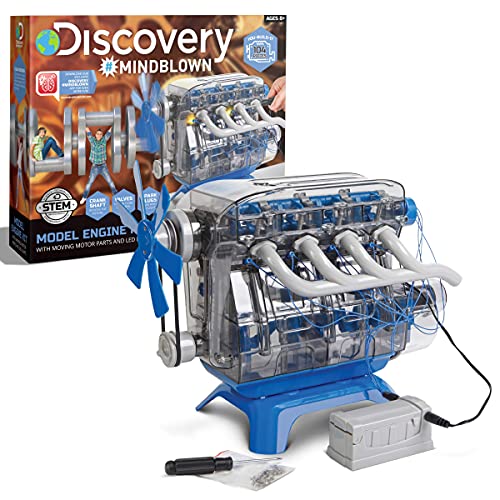
This DIY engine kit includes a fully functional miniature 4-cylinder engine with pistons, fans, belts, belts, and LED indicators. It encourages critical thinking as teens assemble cranks, pulleys, and valves to bring the engine to life. The kit offers tactile assembly and insights into mechanical motion, power transmission, and basic automotive engineering. No batteries are required for core operation, though some components may use a power source to demonstrate lighting or motion in connected parts.
Sillbird Solar Robot Building Kit

The 12-in-1 Sillbird solar robot kit blends outdoor play with solar technology. Teens build multiple solar-powered robots, learning about renewable energy and how solar cells convert light into motion. The kit supports creativity, problem solving, and understanding of energy conversion, plus it can be used with outdoor daylight or indoor artificial lighting. With 190 pieces, it provides a broad set of build options and promotes safe, screen-free STEM exploration.
ELEGOO Uno R3 Smart Robot Car Kit

The ELEGOO Uno R3 kit is an Arduino-compatible platform designed for robotics education. It includes 24 module parts such as obstacle avoidance, line-tracing, infrared controls, and smartphone control compatibility. The project emphasizes programming, electronics assembly, and debugging, with modular components that facilitate incremental learning from basic circuit concepts to more complex autonomous behaviors.
INSOON Mechanical Shark Building Set

The INSOON shark set combines a semi-mechanical body with a gear-driven display base. The model features a movable head, body, and tail via a built-in gear system, plus LED lighting to create a striking display piece. Crafted for teens and older, it emphasizes mechanical design, precision assembly, and understanding how gears enable motion. The kit also serves as decorative art when assembled and displayed on a shelf or desk, appealing to learners who enjoy both mechanics and aesthetics.
Buying Guide: Key Purchase Considerations
- Age and skill alignment: Choose kits labeled for teens or older, with clear instructions and progressive challenges to match advancing abilities.
- Core learning goals: Decide whether the priority is mechanical engineering, electronics and programming, renewable energy, or a blend of design and problem solving.
- Component quality and safety: Look for laser-cut wood or durable plastics, non-toxic materials, and parts that are easy to assemble without specialized tools.
- Hands-on versus screen time: Solar kits and mechanical builds encourage outdoor play and hands-on exploration; electronics and Arduino-compatible kits tend to involve more screen-based programming.
- Future-ready skills: Arduino-compatible kits and modular robots build foundational STEM competencies like coding, circuitry, and systems thinking that transfer to many projects.
- Expansion potential: Consider kits that offer additional projects, spare parts, or compatible accessories to extend learning beyond a single build.
- Storage and display: Larger models with display bases or decorative finishes are suitable for desk spaces and rooms, reinforcing ongoing engagement.
- Budget and value: Compare kit contents and complexity to determine which offers the best long-term learning value relative to price.