Cardboard creativity is on the rise for young builders. This guide highlights five kid-friendly cardboard cutters and construction kits that emphasize safety, learning, and hands-on fun. Each option blends ergonomic design with kid-focused features to support STEM exploration at home or in the classroom.
Summary of Selected Products
| Product | Brand | Key Benefit |
|---|---|---|
| ZLemma Cardboard Construction Kit | ZLemma | Grip Ring safety handle with comprehensive 401-piece set for versatile cardboard builds |
| ACMER Cardboard Tools for Kids | ACMER | All-in-one kid-friendly toolkit with safe cutter design for beginners |
| Fiskars Kids Cardboard Creator | Fiskars | Ergonomic SoftGrip, micro-serrated blade and protective sheath for safe cutting |
| Makedo Discover Cardboard Toolbox | Makedo | Reusable cardboard toolkit enabling group creativity and eco-friendly projects |
| ChompSaw | CHOMPSHOP, INC. | Kid-safe power-tool concept for STEM + STEAM cardboard projects |
ZLemma Cardboard Construction Kit
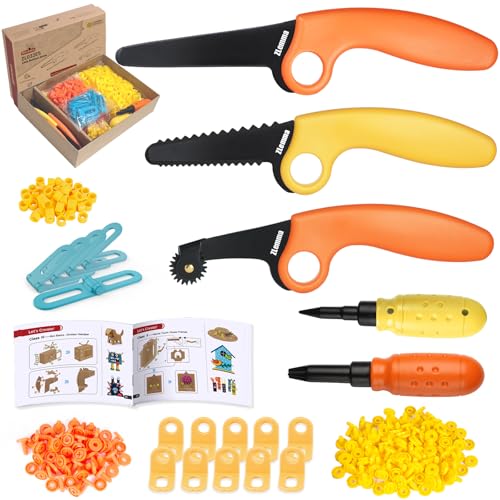
The ZLemma Cardboard Construction Kit combines safety-forward design with a large 401-piece assortment. A signature Grip Ring handle supports secure, comfortable control during cutting, folding, and assembling sessions. Rounded edges and ergonomic grips help limit accidental slips, making it suitable for younger builders who are exploring DIY cardboard projects. The kit centers on a bolt-based building system that yields sturdy yet flexible constructions. Kids can disassemble and reassemble projects, expand with additional materials, and experience real-world engineering concepts through hands-on practice. This kit targets creativity, organization, and safe use in a single package.
Key features include: a professional serrated cutter and child-safe cutters, a crease roller to aid precise folds, and a broad collection of screws, nuts, and connectors. The bolt-and-nut system supports stable structures while allowing modular experimentation. The kit’s versatility makes it a fit for classroom activities, after-school programs, and family projects. With the right guidance, children can explore architectural ideas, light engineering, and decorative finishes, all using upcycled cardboard as the primary material.
ACMER Cardboard Tools for Kids

ACMER offers a compact, all-in-one cardboard construction kit designed with safety and learning in mind. The kit emphasizes a child-friendly cutter design built from durable materials, reducing the risk of injury while enabling younger builders to cut, fold, and assemble with confidence. It supports a range of projects from simple 3D cardboard models to more complex personalized pieces, strengthening fine motor skills and encouraging creative problem solving. The tool set is versatile enough for school projects, home crafting, and group activities, and it’s positioned as a reliable entry point into hands-on STEM exploration for kids aged 3 and up.
Core benefits include its comprehensive approach to cardboard building, encouragement of hands-on experimentation, and alignment with early STEM education goals. By combining practical cutting tools with flexible components, ACMER helps children translate ideas into tangible models, fostering concentration, planning, and iterative design. The kit’s design also emphasizes portability and storage, making it suitable for family craft nights and classroom demonstrations alike.
HORMY Cordless Electric Scissors

HORMY offers a cordless electric cutting solution with a 3.7V battery designed for cardboard, fabrics, and related materials. The unit can reach up to 11,000 RPM, enabling quick cuts for larger or multiple projects. A robust battery life profile supports several hours of use between charges, making it practical for longer crafting sessions. The ergonomic handle is designed to reduce fatigue during extended use, with a safety-minded approach that requires continuous pressing on the switch during operation to minimize accidental starts. This option is best suited for older children under supervision or for adult-assisted sessions where speed is beneficial for larger cardboard tasks.
Considerations for use include managing charging cycles, ensuring appropriate safety, and acknowledging that electric tools may require stricter supervision in a home setting. The tool’s versatility spans cardboard, fabrics, carpets, and more, which can broaden project possibilities but also necessitates careful handling and storage of blades and accessories after each use.
ChompSaw: Kid-Safe Power Tool for Cardboard

ChompSaw redefines cutting tools for kids with a focus on safety and open-ended STEM learning. Marketed as a safe, easy-to-use option, ChompSaw removes sharp blades and spinning components typical of traditional power tools, instead offering a kid-friendly approach to cutting with clear, guided mechanisms. The product positions itself as an engaging entry point for STEAM-oriented projects, enabling young learners to design and execute cardboard builds, from simple shapes to more intricate structures. It is well-suited for classrooms, libraries, and family crafting sessions where safe exploration is paramount.
When evaluating ChompSaw, educators and parents should consider how it complements other tools in a kit, how well it scales with project complexity, and the level of supervision required. Its emphasis on hands-on creation aligns with experiential learning goals, supporting spatial awareness, planning, and collaborative problem solving among groups of young makers.
Buying Guide: Key Purchase Considerations
- Age and safety: Look for tools designed with rounded edges, kid-friendly blades, or blade guards. Safety features and age-appropriate guidance are essential for young builders.
- Tool type: Manual cutters and construction kits cultivate fine motor skills, while cordless electric options offer speed and efficiency for older children. Consider supervision needs and project scope when choosing.
- Durability and materials: Durable plastics, steel components, and sturdy handles reduce breakage during repeated use. Reusable kits encourage ongoing learning and reduce waste.
- Project versatility: Kits with connectors, bolts, nuts, and rollers enable a wide range of projects, from simple models to complex installations. Consider whether you want modular expansion later.
- Storage and organization: A kit with a tidy storage solution helps kids learn organization and makes cleanup part of the project routine.
- Educational value: Look for kits that promote STEM/STEAM concepts like geometry, engineering, spatial reasoning, and problem solving.
- Environmental impact: Reusable materials and upcycled cardboard align with sustainability goals and teach eco-friendly practices.
- Classroom and family use: Some tools are better suited for shared spaces, with features that support group projects or at-home family crafting sessions.
In selecting a cardboard cutter for kids, weigh safety against creative potential. Manual kits encourage methodical planning and hands-on exploration, while electric options may accelerate more ambitious projects under proper supervision. A well-rounded choice often combines several tools to cover different project scales, from quick models to larger constructions, ensuring ongoing engagement and learning.