Counting blocks and math manipulatives help young learners build a strong foundation in number sense, patterns, and basic arithmetic. The following five products feature clear color coding, durable designs, and kid-friendly shapes that support counting, sorting, and problem-solving. Perfect for classrooms, homeschooling, and play-based learning, these sets offer versatile activities—from simple counting to more complex patterning and graphing. Explore options that align with early math milestones and help kids develop fine motor skills while staying engaged with hands-on discovery.
| Product | Brand | Highlights | Link |
|---|---|---|---|
| Learning Resources MathLink Cubes – Set of 100 Cubes | Learning Resources | Counting to 100, skip counting, patterns, graphing, fine motor skills | View Product |
| edxeducation Math Cubes | Set of 100 | edxeducation | Five shapes on each cube, color sorting, versatile classroom manipulatives | View Product |
| SpriteGru Math Linking Cubes, Set of 100 | SpriteGru | 10 vibrant colors, counting, sorting, early STEM | View Product |
| hand2mind MathLink Cubes Numberblocks 1-10 | hand2mind | Numberblocks licensing, hands-on counting, early math skills | View Product |
| Learning Resources MathLink Cubes Big Builders | Learning Resources | 200 cubes, imagination-driven building, early engineering | View Product |
Summary: The selected products provide a range of counting blocks suitable for preschool to early elementary learners. Each set emphasizes counting, color and shape recognition, patterning, and basic operations through hands-on play. When selecting, consider price-per-use, material durability, color variety, and the number of pieces to support different group sizes and activities.
Learning Resources MathLink Cubes – Set of 100 Cubes
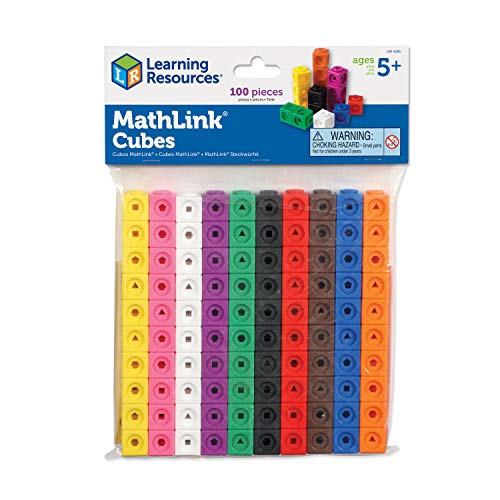
The 100-cube set supports a wide range of early math activities. Students can practice one-to-one correspondence, count to 100, and perform skip counting. The cubes facilitate comparison tasks, formation of 10s, and nonstandard measurements. Teachers and homeschool parents can integrate these cubes into patterning, matching, and graphing exercises. The bright colors and snap-together design help with fine motor skills, eye-hand coordination, and motor planning. The included shapes allow for more complex patterning and multi-step tasks, making this a versatile classroom tool.
edxeducation Math Cubes | Set of 100

This 100-count set features five distinct shapes on each cube, with ten color options. The design supports a range of counting activities, from basic addition and subtraction to more advanced sorting and patterning. The five-sided faces promote geometric recognition and shape sorting, while the color variety reinforces color-moding in math tasks. Students can link and rearrange cubes to explore place value, compare quantities, and create simple patterns, all while improving fine motor coordination through snapping and manipulating the pieces.
SpriteGru Math Linking Cubes

SpriteGru offers a 100-piece set in ten colors designed to support counting, sorting, and early STEM skills. The colorful cubes are easily linked to create tall towers or extended patterns, helping children visualize quantities and place value in a tactile way. The packaging promotes collaborative play and guided activities that encourage children to describe patterns, compare numbers, and solve simple equations. This set is well-suited for small group activities and individual exploration alike, with a focus on creativity and critical thinking through hands-on manipulation.
hand2mind MathLink Cubes Numberblocks 1-10

Licensed with Numberblocks branding, this activity set introduces children to ten characters built from the counting cubes. It emphasizes counting, basic arithmetic, and early number sense through interactive exploration. The Numberblocks-themed cubes enable kids to visualize numbers and operations by constructing familiar characters. This tangible approach supports enduring concepts such as addition, subtraction, and even early multiplication in a playful, story-driven context, which can increase engagement during math centers or independent practice.
Learning Resources MathLink Cubes Big Builders

The Big Builders set contains 200 cubes, supporting larger-scale projects and collaborative activities. The expanded quantity encourages group problem solving, engineering-minded challenges, and imaginative play. By constructing vehicles, structures, or abstract designs, kids explore spatial reasoning, balance, and measurement concepts. The set complements standard counting tasks with opportunities to discuss symmetry, repetition, and scale, enabling teachers and parents to design multi-step lessons that integrate math with science and engineering thinking.
Buying Guide
Key purchase considerations help ensure an optimal fit for a child’s developmental stage and learning goals.
- Piece count and scalability: Start with sets of 100 for individual practice or small groups, and consider larger kits (200 pieces) for extended projects and classroom activities.
- Color and shape variety: Different colors aid sorting, grouping, and color-based math tasks. Include cubes with varied shapes to introduce geometric thinking and patterning.
- Durability and material: Look for sturdy plastic or wooden construction with smooth edges. Durable cubes withstand frequent handling in classrooms and homes.
- Educational alignment: Choose sets that support early math concepts—counting to 100, place value, basic operations, and patterning. Some sets align with popular character themes for increased engagement.
- Storage and organization: Consider sets that come with containers or clearly labeled bags to facilitate easy cleanup and rotation in centers.
- Safety and age range: Ensure the recommended age range fits your child. Smaller pieces may be a choke risk for younger children; supervise as needed.
- Teacher and homeschool utility: For educators, sets that promote group work, data collection, and formative assessment are advantageous. For homeschooling, versatile activity ideas are valuable for daily practice.
- Expansion opportunities: If you anticipate adding more blocks later, verify compatibility between different brands for seamless combination in activities and larger constructions.
In choosing counting blocks, balance the number of pieces with the kinds of activities you plan to conduct. A mix of sets that emphasizes counting, patterning, and basic arithmetic will provide a well-rounded foundation for early math skills, while themed options can boost motivation and ongoing engagement across various learning contexts.