This guide highlights engaging, age-appropriate educational toys for four-year-olds. Each pick supports early literacy, science curiosity, math readiness, and imaginative play, helping kids develop essential skills while having fun. Below, a quick summary table introduces five standout products, followed by detailed sections with features and practical use ideas.
| Product | Key Benefit | |
|---|---|---|
| LeapFrog Mr Pencil’s Scribble Write and Read | LeapFrog | Letter tracing and name writing with animated feedback |
| Educational Insights GeoSafari Jr. Talking Microscope | Educational Insights | Early science exploration with guided narration |
| ThinkFun Zingo Bingo | ThinkFun | Language skills and picture-word recognition |
| LIWIN LET’S GO! Matching Letter Game | LIWIN LET’S GO! | Letter recognition and memory through matching |
| Doctor Jupiter Little Genius Kit | Doctor Jupiter | STEM activities and hands-on science experiments |
Note: This selection emphasizes interactive, educator-approved activities that suit homeschooling, preschool classrooms, and family playtime. Each item supports different learning modalities—visual, auditory, tactile—so kids can explore at their own pace while building foundational skills.
LeapFrog Mr Pencil’s Scribble Write and Read

Mr. Pencil guides young writers through uppercase and lowercase letters with step-by-step tracing. The letters morph into animated animals and objects, reinforcing letter shapes and phonics. The toy also supports tracing numbers via dotted lines and evolves into counting activities. A customizable feature lets a child’s full name be written for practice. These elements foster handwriting readiness, letter recognition, and early numeracy in a playful format.
Educational Insights GeoSafari Jr. Talking Kids Microscope

This preschool-friendly microscope introduces science in an approachable way with close-up imagery and the voice of Bindi Irwin guiding exploration. By looking at animals, plants, and tiny structures, children learn observational skills and basic biology concepts. The talking feature reinforces vocabulary and curiosity while keeping sessions engaging and age-appropriate. Colors and accessories may vary as part of product transitions.
ThinkFun Zingo Bingo

Zingo Bingo is a fast-paced, beginner-level game that supports language development and matching skills. It’s designed for pre-readers and early readers, helping kids recognize words, pictures, and related sounds through engaging play. The game fosters turn-taking, social interaction, and cognitive flexibility, making it a classroom-friendly and home-friendly option for active learners.
LIWIN LET’S GO! Matching Letter Game
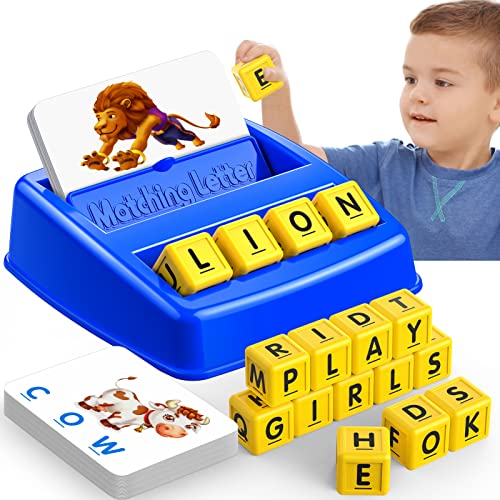
These matching letter cards support early literacy by promoting letter recognition, memory, and word-building skills. The game encourages parent-child interaction, inviting adults to guide children through vocabulary-building activities such as identifying letters, forming simple words, and practicing spelling. The design aims to balance independent play with collaborative learning, helping kids build confidence in language tasks.
Doctor Jupiter Little Genius Kit

The Little Genius Kit offers a well-rounded science and math experience for ages 4-6, including a maths game, science experiments, a language game, and an animal encyclopedia with real-world images. With 15 experiments and 50+ stickers, this kit emphasizes hands-on inquiry, measurement, and observation. The materials are designed to be safe for young learners and suitable for guided or independent exploration in a classroom or at home.
Buying Guide: Key Purchase Considerations
- Learning goals: Choose toys that align with literacy, math readiness, science curiosity, and fine motor skills to cover multiple developmental areas.
- Mode of play: Include options for screen-free activities, social play, and guided learning with adults to balance independence and support.
- Age appropriateness: Confirm the recommended age range to ensure the level of challenge is suitable for a four-year-old.
- Durability and safety: Look for sturdy construction, non-toxic materials, and small parts that comply with safety guidelines for young children.
- Flexibility: Prefer toys that can adapt to growing skills or offer multiple activities within one product to extend usability.
- Educational content: Consider whether the toy reinforces phonics, counting, science vocabulary, or problem-solving strategies.
- Setup and cleanup: Assess ease of assembly and storage to encourage routine use and minimize frustration.
- Social and classroom value: Some options are ideal for cooperative play or small-group activities in preschool environments.
In summary, the chosen products provide a balanced mix of literacy, science, math, and language-play opportunities. Evaluating each item against your child’s interests, routine, and learning pace can help select tools that sustain curiosity and foster foundational skills during the critical preschool years.