Electronic toys designed for toddlers blend playful exploration with early literacy and numeracy skills. This guide highlights five top picks that emphasize hands-on learning, safe design, and engaging features for young children. Each product is evaluated for durability, age appropriateness, and developmental value, helping caregivers choose tools that foster curiosity and cognitive growth while keeping playtime fun and safe.
| Product | Brand | Key Benefit |
|---|---|---|
| LeapFrog 2-in-1 LeapTop Touch, Green | LeapFrog | Flexible keyboard/tablet modes for early typing and word building |
| Fisher-Price Laugh & Learn Smart Stages Tablet | Fisher-Price | Three stages of learning with songs, sounds, and interactive lights |
| LeapFrog Learning Friends 100 Words Book | LeapFrog | Over 100 words with themed categories and interactive sound effects |
| VTech Toddler Tech Laptop | VTech | Cause-and-effect play with multiple apps and interactive features |
| LeapFrog Chat and Count Emoji Phone | LeapFrog | Role-play communication with counting, emoji sounds, and videos |
LeapFrog 2-in-1 LeapTop Touch, Green

The LeapTop Touch blends a kid-friendly laptop and a tablet in one compact device suitable for preschoolers. Its screen flips between a traditional keyboard layout and a touch tablet surface, encouraging pretend play and early tech familiarity. The keyboard includes letters A–Z and numbers 1–10, supporting basic alphabet and numeral recognition. The swivel mechanism allows children to transform the device for different play scenarios, such as email-style role play or drawing activities. Parents can customize experiences to help children spell their own name, adding a personal learning element.
In addition to role-play features, the LeapTop Touch emphasizes fine motor development through button presses, swiveling, and screen interactions. The device offers age-appropriate content that aligns with early literacy goals while maintaining a playful, safe design. Durability and kid-friendly materials make it suitable for everyday use, and the device’s dual modes encourage kids to switch between reading activities and motion-based exploration. This variety supports gradual skill-building without overwhelming young learners.
Fisher-Price Laugh & Learn Smart Stages Tablet

The Fisher-Price Laugh & Learn Smart Stages Tablet is an engaging pretend device designed for toddlers ages 1 and up. It features 100+ songs, sounds, and phrases that align with the three Smart Stages levels, allowing the content to grow with the child. Alphabet recognition, colors, shapes, and familiar objects are introduced through interactive lights and cues. With 28 app-like buttons, children can press to activate music and lights, fostering cause-and-effect understanding and memory recall. The bright visuals and friendly voice prompts keep toddlers motivated to explore while learning basic concepts.
Safety and simplicity are central to this toy. Buttons are large and clearly labeled, reducing confusion and encouraging repeated practice. The device’s screen presents age-appropriate visuals, and the overall form is sturdy enough for rough toddler play. While designed for guided play, it also supports independent exploration, helping children develop concentration and early computational thinking through structured, multisensory experiences.
LeapFrog Learning Friends 100 Words Book, Green
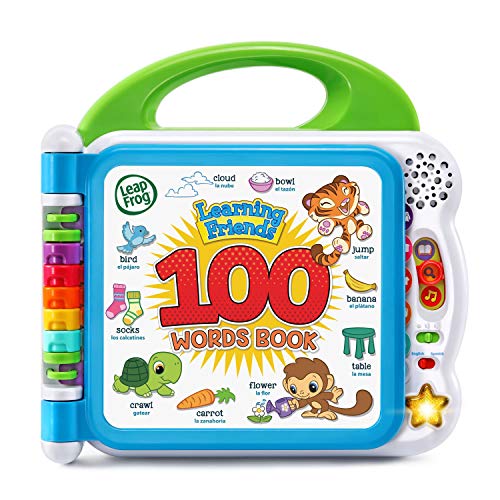
This interactive learning book features familiar characters—Turtle, Tiger, and Monkey—to introduce more than 100 words selected by learning experts. Word categories cover pets, animals, food, colors, activities, opposites, and more, offering broad vocabulary exposure. Touching words on the pages triggers spoken words, sound effects, and fun facts, reinforcing auditory and visual associations. A light-up star button plays a Learning Friends theme song and a favorite word track, encouraging repetition and memory retention. The book format makes it portable and easy to use in different play settings.
Adult involvement can be minimal, as most interactions are self-guided, yet caregivers can extend learning with simple prompts or picture-based questions. The content is designed to promote early literacy, phonemic awareness, and word recognition, while the durable construction helps withstand toddler handling. This option provides a gentle introduction to vocabulary in a familiar, book-like format that complements screen-free learning time.
VTech Toddler Tech Laptop
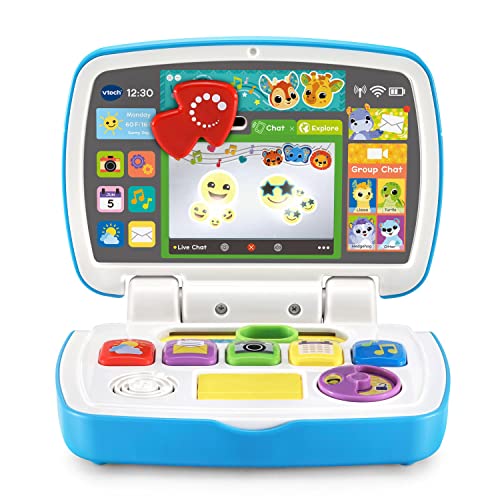
The VTech Toddler Tech Laptop introduces basic computer-like play with a focus on cause-and-effect learning. Five app-style buttons cover daily topics such as weather, email, camera, calendar, and music, providing practical language and cognitive cues. A spinning disk, slider, and moving arrow introduce fine motor skills and prompt exploration through tactile feedback. Songs and phrases delivered during play reinforce memory and language development, while colorful visuals and approachable icons keep toddlers engaged. The device encourages imitation of adult technology use in safe, age-appropriate form.
Designed for durability, the laptop-style toy withstands frequent handling and drops, common in toddler play. It offers structured yet open-ended play, letting children explore how different actions produce responses. For caregivers, this toy can serve as a foundation for daily routine conversations (weather checks, calendar events) while supporting early exposure to technology concepts in a non-screen-heavy format.
LeapFrog Chat and Count Emoji Phone

This toddler-friendly pretend phone enables imaginative conversations with Scout and other characters, blending role-play with basic counting activities. The light-up number buttons enable counting from 0 to 10 with engaging animations, helping children connect numbers to tangible actions. A video button showcases short clips featuring Scout, while the emoji feature adds expressive play suitable for social interaction concepts. The toy supports early communication skills, turn-taking, and vocabulary expansion in a playful phone-themed context that mirrors real-world devices without complex interfaces.
Durability and safety are central to this device, with clearly defined buttons and a compact form that fits small hands. The toy’s design encourages social play, storytelling, and sequencing—key milestones for toddlers. It also provides a gentle bridge to more advanced digital devices as children grow, aligning with curricula that emphasize language development and numerical familiarity through familiar play patterns.
Buying Guide
Key purchase considerations for electronic toys for toddlers include safety, durability, and age-appropriate content. Look for sturdy construction with rounded edges, non-toxic materials, and buttons that respond reliably to small hands. Consider whether the toy supports either screen-based or screen-free learning, as children benefit from a mix of formats. Content should align with early literacy, numeracy, and language development goals, introducing numbers, letters, words, shapes, and basic concepts without overwhelming the child.
Developmental appropriateness matters: choose toys that match the child’s current skill level while offering room to grow. Toys with multiple modes or levels (such as songs, touch responses, and progressive learning stages) can adapt to a child’s advancing abilities. When possible, prefer toys that encourage independent exploration but also allow caregiver-guided activities to extend learning. Finally, consider portability and ease of cleanup, since toddlers often learn in various spaces and travel-friendly devices support consistent play routines.
Comparative perspectives help: some caregivers prioritize screen-based experiences for vocabulary and rhythm, while others favor tactile, non-screen play to reinforce fine motor skills and social interactions. The selected five options provide a balanced mix of tablet-like experiences (LeapTop Touch, Laugh & Learn Tablet, Learning Friends Book, Emoji Phone, and Toddler Tech Laptop) and cross-cutting play scenarios that support language, counting, and imaginative role-play. Evaluating your child’s interests, attention span, and daily routine will guide the best fit for enhancing early learning through electronic toys.