Kids who love machines can learn science, engineering, and problem solving by building their own working engine models. The following selection highlights five engaging, child-friendly kits that reveal how pistons, gears, and valves come together. Each kit offers hands-on assembly, realistic motion, and educational insights suited for ages 8 and up, with options that also appeal to adults who enjoy DIY engineering projects. The table below shows key details at a glance to help you compare features quickly.
| Product | Brand | Notes |
|---|---|---|
| Discovery Model Engine Building Kit | Discovery | 4‑cylinder, LED lights, working pistons |
| Playz V8 Combustion Engine Model Kit | Playz | Visible V8, runs with cables, requires batteries |
| Mould King Mini V8 Engine Kit | Mould King | 487 pcs, transparent cylinder head, detailed design |
| WINGIFT V8 Engine Building Set | WINGIFT | Visible V8, rechargeable motor, LED lights |
| Playz Inline 6 Engine Model Kit | Playz | Inline 6, 230 parts, runs and sounds |
Discovery Model Engine Building Kit
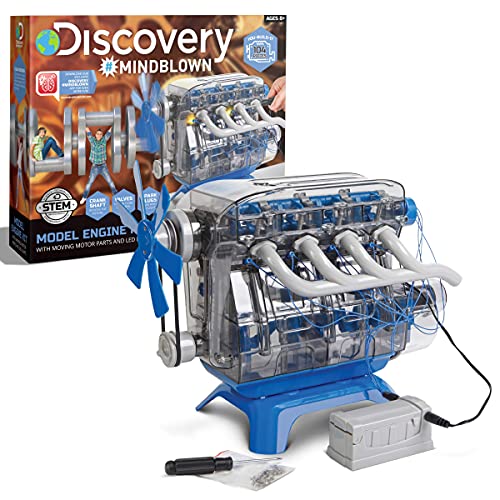
The Discovery kit introduces young builders to a four-cylinder engine with moving pistons, fan, valves, belts, and LED lights. This kit emphasizes critical thinking as kids or adults assemble components to make the engine “come alive.” The set includes practical tools and interactive parts that demonstrate how crankshafts and exhaust systems coordinate to power a model engine. The result is a tangible, visual demonstration of inner engine mechanics, useful for classrooms or family science projects.
Playz V8 Combustion Engine Model Kit

The Playz V8 model offers a fully visible 8-cylinder engine with realistic motion and sounds. Designed for both adults and kids aged 12+, it provides an interactive experience with cranks, pulleys, belts, and exhaust valves that drive the engine. The kit’s comprehensive parts set fosters mechanical reasoning as builders observe how each component contributes to engine performance. Battery-powered operation adds a practical, real-world feel to the assembly process.
Mould King Mini V8 Engine Kit

This model is a high-detail V8 engine with a transparent cylinder head, allowing clear observation of piston motion and turbocharger simulations. The 487-piece kit suits teens and adults who appreciate precision engineering and display-quality models. Builders can study how gears and valve trains interact inside a compact, intricate engine, making it a strong choice for enthusiasts who want both educational value and a collectible model.
WINGIFT V8 Engine Building Set

The WINGIFT V8 kit combines realism with an interactive learning experience. It features a transparent cylinder head, an L-type motor, and a rechargeable power unit with LEDs that illuminate the engine as it runs. Aimed at ages 14 and up, this set emphasizes hands-on problem solving, sequencing, and mechanical comprehension. The included motor and battery setup enable sustained demonstrations of engine operation, making it suitable for classrooms or family STEM projects.
Playz Inline 6 Engine Model Kit

The Inline 6 kit mirrors the structure of a six-cylinder engine, offering a detailed, hands-on project for adults and older kids. The 230-piece set focuses on a smooth four-stroke cycle and piston motion, giving learners a practical sense of how inline configurations operate. This kit complements V8 models by expanding understanding of engine layouts and mechanical coordination, while remaining approachable for beginners who want a challenging yet achievable build.
Buying Guide: Key Purchase Considerations for Engine Kits
- Age appropriateness and complexity: Some kits are designed for younger builders with simpler assemblies, while others target teens and adults with advanced mechanisms and more parts. Match the kit to the builder’s experience and patience level.
- Educational goals: If the aim is to understand piston motion, valve trains, and crankshafts, choose kits with clear mechanical demonstrations, visible components, and rotating parts that illustrate core concepts.
- Power and operation: Consider whether the engine runs on batteries, USB power, or requires an external power source. Some sets include LED lighting or sound effects for a more immersive experience.
- Realism vs. display: Some models prioritize lifelike details (transparent heads, turbochargers) for display, while others emphasize functionality (moving pistons, rotating fans). Decide whether the priority is visual accuracy or mechanical realism.
- Build quality and parts count: Higher-piece kits often offer more detailed assemblies and longer projects, but they can be more challenging. Check for sturdy connectors and clear instructions.
- Expandability: If your interest might grow, look for kits with compatible parts or sets that allow additional engines to be built later without starting from scratch.
- Care and safety: Ensure the kit uses child-safe materials and includes protective gear or guidance for handling small parts. Supervision is recommended for younger builders.
- Storage and organization: Some sets come with organized trays or bins to keep small components tidy, which helps maintain ongoing projects and avoids loss of parts.
- Consider your primary goal: demonstration of internal mechanics, or enjoyment of a detailed build that can be displayed or kept as a model.
- Balance cost versus learning value: More complex sets may offer richer learning experiences but require more time and effort to complete.
- Check compatibility with future projects: If you plan to collect multiple kits, verify whether parts interoperate or if separate themes (V8, inline 6, etc.) exist.