When you want consistent, accurate boosts for your bottle rockets, fins are the foundation. They guide airflow, reduce wobble, and help you climb higher and straighter. This guide highlights the best fins and fin-and-launch kits designed for 2-liter and smaller soda bottles. Each option emphasizes quick, tool-free assembly, reliable compatibility, and durable materials so you can maximize launches at your next backyard science demo or school project.
| Product | Brand | Type | Key Benefit |
|---|---|---|---|
| StratoFins Screw-on Water Rocket Fins | Relationshipware | Screw-on Fins | Broad compatibility; no tools |
| StratoFins Screw-on + Rubber Stopper Launcher | Relationshipware | Fins + Launcher | Easy assembly; versatile launcher styles |
| StratoFins Screw-on + Parachute Kit | Relationshipware | Fins + Parachute | Safe returns for many flights |
| EZ-Launch Bottle Rocket Booster Fins | EZ-Launch | Fins | Durable ABS; high-airlift potential |
| StratoLauncher IV + StratoFins | Relationshipware | Launcher + Fins | Powerful reach; integrated system |
StratoFins Screw-on Water Rocket Fins

The StratoFins screw-on fins are designed for 2 liter bottles or smaller, making them compatible with most launch setups. They require no tools or glue for assembly, simplifying field setups or classroom demonstrations. The fins are built to work with various attachment methods, including cable ties, rubber stoppers, expanding tubes, nozzles, or O-rings, increasing versatility for different launch configurations. A key benefit is broad compatibility with both homemade and commercially available launchers, which helps reduce the time spent on setup and increases flight consistency.
Material and design decisions focus on durability and repeatable performance. Since the fins screw directly onto the bottle, you can quickly swap fins between rockets or adjust configurations for stability. This is important when you want to test different fin counts or shapes to observe how yaw and pitch behavior changes during ascent. The fins’ simple integration makes them a popular choice for students and hobbyists who value straightforward assembly without sacrificing flight reliability.
StratoFins Screw-on + Rubber Stopper Launcher

This dual-pack combo pairs StratoFins with a rubber stopper launcher, delivering a ready-to-run system that many beginners prefer. The fins remain screw-on, preserving quick setup and easy removal for adjustments between flights. The launcher component supports several attachment methods, including cable ties and stoppers, ensuring compatibility with a range of 2-liter bottles and smaller. The kit’s emphasis on simplicity makes it ideal for classroom demonstrations or community science fairs where time and reliability matter.
From a physics perspective, the fins’ straight, convergent edges encourage stable lift and reduce wobble as the bottle accelerates. The absence of required tools means students can focus on experimentation—altering fin spacing, testing with and without parachutes, or comparing different launcher styles. The flexible assembly encourages iterative testing while keeping the risk of misalignment low.
StratoChute 24″ Parachute Kit
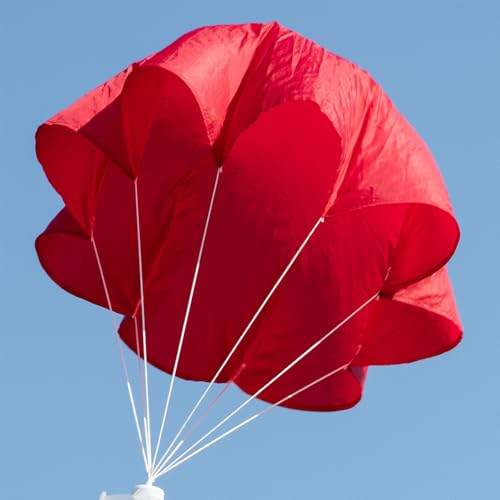
The 24″ red Rip-stop nylon parachute is designed to safely recover a water or model rocket after flight. With six sides and six braided shroud lines, the parachute provides robust deployment and consistent descent. The shroud lines loop over the fins attached to a 2-liter bottle and are gathered at the top with a cable tie, simplifying installation on a wide range of rockets. Reusable parachutes extend the number of launches you can perform, making this option attractive for ongoing demonstrations or school labs.
Parachute-assisted recovery reduces impact risk during landings, particularly on hard surfaces. The textile is durable and compact enough to store with the rocket kit, and the 24-inch diameter balances drag and descent rate for mid-to-high-arc flights. When used with StratoFins, the overall system improves flight safety and post-flight analysis opportunities for students studying aerodynamics and trajectory planning.
EZ-Launch Bottle Rocket Booster Fins
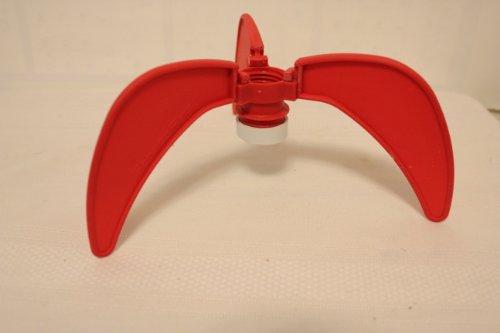
These red injection-molded ABS fins are designed for durability and high altitude potential. The booster fins aim to maximize lift, enabling rockets to reach 500 feet or more in favorable conditions. They are intended for use in open, grassy areas away from obstacles such as trees and power lines, where launches can be performed safely and repeatedly. The emphasis on durability makes them a good fit for repeated school demonstrations or extended hobby use where rough handling is possible during transport and setup.
The ABS construction provides a balance between rigidity and impact resistance, reducing the risk of damage from rough landings. Because the fins are designed for robust performance, they work best when paired with a stable bottle radius and proper nozzle alignment. Users can pair these with a compatible launcher to create a straightforward, repeatable launch experience.
StratoFins Screw-on Water Rocket Fins + Parachute Kit

This package combines StratoFins with a parachute for safer, repeatable landings. The fins remain screw-on for quick interchangeability between rockets, and the parachute is designed for compatibility with 2-liter bottles. The kit’s design focuses on minimizing post-flight damage while maximizing recovery reliability, enabling more launches per session. It’s a practical option for educators and hobbyists who want a ready-to-run system that balances ascent stability with safe returns.
Flight stability benefits from the fins’ robust mounting method and the parachute’s controlled drag during descent. The kit supports experimentation with different release conditions, including varied water loads and nozzle choices, to study how recovery dynamics affect overall flight cycles. This combination can help students visualize energy conversion from potential to kinetic to potential again during multiple trials.
Relationshipware StratoLauncher IV + StratoFins

The StratoLauncher IV kit merges a metal water rocket launcher with StratoFins, providing a full launch system. The launcher features a 125 PSI safety valve, offering controlled pressure for consistent flights. The kit also includes an aerodynamic nose cone and a funnel for easy assembly. It’s designed for 2-liter bottles and supports several launch configurations, making it a strong option for clubs or advanced classrooms seeking a comprehensive, repeatable setup.
Important notes include the aerodynamic nose cone requirement for straight flight and the recommended use of only modest water volumes to maintain stability. The combination of a capable launcher with screw-on fins aids in reducing setup variability between launches, enabling systematic testing of fin configurations and flight angles. This system is well-suited for performance-focused demonstrations and more detailed trajectory analyses.
Buying Guide: Key Purchase Considerations and Comparisons
- Compatibility: Check whether fins work with standard 2-liter bottles and a range of launcher types. Screw-on designs tend to offer quicker swaps between rockets.
- Assembly: Look for tool-free installation to maximize setup speed in classrooms or busy science fairs. Parachute options add safety and reuse potential.
- Materials and Durability: ABS and nylon parachutes provide durability for repeated launches; fabric parachutes should be inspected for wear between flights.
- Recovery vs. Propulsion Balance: Fins improve stability, but parachutes introduce drag that slows ascent and descent—consider test scenarios with and without parachutes to observe effects on flight duration and peak altitude.
- System Integration: Some kits pair fins with launchers, offering an all-in-one solution. This can simplify procurement and ensure component compatibility for consistent results.
- Safety and Environment: Choose open, grassy launch areas and follow local safety guidelines. Ensure recovery systems minimize impact on landing surfaces and surroundings.
- Educational Value: Favor kits that support iterative testing, such as varying fin shapes, counts, or attachment methods, to illustrate aerodynamic concepts like stability, drag, and center of pressure.