Finding engaging, educational toys for preschoolers can spark curiosity and build foundational math skills through play. The following selections emphasize counting, patterns, and basic arithmetic using tactile, colorful designs suitable for ages 3 and up. Each option supports hands-on exploration, visual learning, and safe, durable construction so children can practice early math concepts while having fun.
| Product | Brand | Key Benefit |
|---|---|---|
| Frog Balance Counting Toys (63 PCS) | lonfypeng | Balance-based number concepts and early problem-solving |
| MathLink Cubes Numberblocks 1-10 Activity Set | hand2mind | Hands-on number building and basic operations |
| Self-Correcting Wooden Number Puzzles | Melissa & Doug | Matching and counting with storage for organization |
| MathLink Cubes 100 Cubes | Learning Resources | Comprehensive math manipulatives for counting and patterns |
| Montessori Number Blocks Counting Peg Board | ISMETACU | Counting, sorting, and pattern practice with durable wood |
Lonfypeng Frog Balance Counting Toys

The Lonfypeng Frog Balance Counting Toys offer an integrated approach to early numeracy by combining a balance scale with counting pieces and learning cards. The set includes 30 double-sided cards, 19 small statues, two weighing plates, one scale, and a base. Children use the card prompts to choose the appropriate number of statues and place them on the two sides of the scale, learning relationships between numbers, weight, and balance through observation. The material supports concepts like number patterns, addition and subtraction basics, and the idea that numbers describe weight and balance. The design emphasizes stability and safety for preschool play, enabling guided exploration with minimal supervision. Teachers and parents can adapt the activities to focus on counting, comparison, or simple problem-solving challenges. This is a robust option for family math time or classroom centers.
Key features include interactive balance lessons, a variety of number modes on the cards, and a durable, kid-friendly build. The kit’s tactile pieces help reinforce cognitive connections between quantities and balance states, making it a strong choice for kinesthetic learners who learn best by manipulating objects.
MathLink Cubes Numberblocks 1-10 Activity Set

From the Numberblocks series, this officially licensed MathLink Cubes activity set provides hands-on number construction from One to Ten. Children build Numberblocks to visualize counting, addition, subtraction, and basic multiplication concepts through tangible manipulation. The set is well-suited for ages 3-5 and aligns with guided play or independent exploration. By connecting cubes to form characters and patterns, kids develop one-to-one correspondence, counting fluency, and early computational thinking in an approachable, visual way. Educators can use the blocks to model counting sequences, simple equations, and patterning tasks in a classroom or homeschool setting.
Included activities encourage counting to 100 through progressive construction, supporting early math readiness and deeper number sense. The design emphasizes portability and repeated use, allowing caregivers to adapt challenges as a child grows. The Name-to-Number linkage presented by the Numberblocks fosters engagement and sustained interest in foundational math skills.
Melissa & Doug Self-Correcting Wooden Number Puzzles

These wooden number puzzles from Melissa & Doug offer a self-correcting design that helps preschoolers practice matching, counting, and number recognition. The set includes 40 pieces with color pictures that depict familiar objects, supporting quick visual associations with quantities. The wooden storage box with a slide-in lid keeps pieces organized and ready for quick cleanup after play sessions. The puzzles promote fine motor development, hand-eye coordination, and cognitive flexibility as children link numerals to quantities, then check their answers by finding matching picture tiles. The durable construction makes the puzzles suitable for daily classroom or home use, while the self-correcting feature reduces frustration and encourages independent problem-solving.
Parents and teachers can use these to introduce early math vocabulary (equal, more, less, count) and to reinforce counting sequences. The set is versatile for guided instruction or free play, and it integrates well with other manipulatives for a broader math center.
MathLink Cubes 100 Cubes
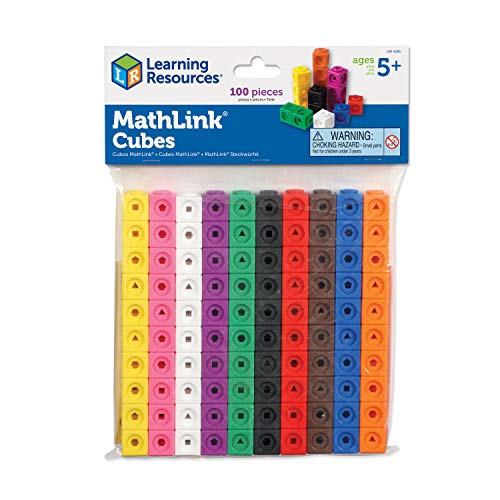
The Learning Resources MathLink Cubes set offers a compact, versatile collection for building early math skills. With 100 cubes, children explore counting to 100, one-to-one correspondence, skip counting, and basic operations such as addition and subtraction. The cubes are color-coded to aid patterning, shape and color identification, and visual estimation, which helps with early measurement concepts. The kit supports group activities, independent practice, and homeschool use, and it can be paired with other manipulatives to expand lessons in place-value, graphing, and data collection. The durable plastic cubes are easy to connect and separate, encouraging prolonged engagement and experimentation with math ideas.
Beyond basic counting, this set supports more complex tasks like making ten, comparing quantities, and basic multiplication early on through repeated addition. The kit’s portability makes it ideal for small-group centers or travel-friendly learning, and its systematic design helps teachers scaffold progressively challenging activities across a math block.
ISMETACU Wooden Montessori Number Blocks

This Montessori-inspired counting peg board by ISMETACU introduces basic math concepts through tactile play. The wooden board, bright pegs, and counting blocks support counting, sorting, and pattern recognition. Safe, durable, and suitable for individual or small-group activities, this toy encourages hands-on exploration of numerical relationships and sequencing. Children can build simple patterns, explore grouping, and physically manipulate quantities to reinforce early arithmetic concepts. The sturdy construction ensures longevity in home use or classroom settings, and the peg-based learning approach aligns well with Montessori principles, promoting independent discovery and self-paced skill development.
Educators and parents can integrate this toy into guided lessons on number sense, including counting to ten, recognizing quantities, and exploring order. The durable design also supports classroom rotations, making it a practical addition to a math center focused on early numeracy skills.
Buying Guide: Key Purchase Considerations and Comparisons
When selecting math toys for preschoolers, consider age appropriateness, alignment with learning goals, and how the toy supports different styles of play. Here are factors to help compare options:
- Learning objectives: Choose tools that target counting, number recognition, basic operations, and patterning. Some sets emphasize balance and measurement, others focus on number construction or puzzle matching.
- Hands-on engagement: Toys with manipulatives, such as cubes, blocks, and scales, provide tactile experiences that reinforce concepts, especially for kinesthetic learners.
- Safety and durability: Look for non-toxic materials, rounded edges, and sturdy construction suitable for frequent use by curious preschoolers.
- Growth potential: Consider how easily a toy scales with new challenges (e.g., moving from counting to basic addition, or introducing patterns and graphing).
- Storage and organization: In sets with many pieces, a box or tray helps with cleanup and independent playtime.
- Educational alignment: Some products tie to popular media (Numberblocks) or Montessori methods, which can influence engagement and classroom integration.
- Social play: Group-friendly designs support collaborative activities, turn-taking, and guided lessons with a teacher or parent.
For readers seeking a balanced mix, combining a number-building set (like MathLink Cubes) with a Montessori-style peg board or a balance-scale activity provides different perspectives on numbers. This variety supports counting fluency, one-to-one correspondence, and early problem-solving in diverse settings—home, classroom, or tutoring sessions. Consider pairing any single toy with simple daily math routines, such as “count and compare” games or “build and balance” challenges, to maximize learning outcomes while keeping play enjoyable.