Pretend play helps toddlers develop language, social skills, and problem-solving abilities. The following five toys are designed for one-year-olds and emphasize safe materials, simple actions, and engaging sounds or visuals. Each section includes a clickable Amazon link, an image, and key features to help parents compare options at a glance.
The table below summarizes the selected products, including brand and a snapshot of their educational focus:
| Product | Brand | Educational Focus | Key Feature Highlight |
|---|---|---|---|
| LeapFrog Yum-2-3 Toaster | LeapFrog | Counting, colors, pretend kitchen play | Three food buttons; nine play pieces |
| Fisher-Price Laugh & Learn Coffee Café | Fisher-Price | Songs, sounds, early learning concepts | 100+ songs and 10 play pieces |
| Fisher-Price Chatter Telephone | Fisher-Price | Numbers, social play cues | Rotary dial; moving eyes |
| Fisher-Price Laugh & Learn Piggy Bank | Fisher-Price | Numbers, colors; early math | 40+ songs and phrases; back bank drop |
| Wolmund Toy Learning Phone | Wolmund | Multi-mode learning; sensory engagement | 8 modes; LED visuals |
LeapFrog Yum-2-3 Toaster
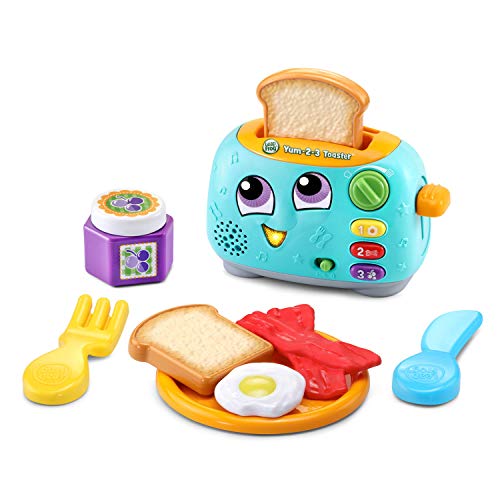
The LeapFrog Yum-2-3 Toaster invites toddlers to engage in imaginative kitchen play while reinforcing basic numeric concepts and color recognition. The toy includes three food buttons and nine pieces, such as bread slices, a jelly jar, an egg, and bacon, all presented on a plate with a fork and knife. This setup supports pretend role-play and fine motor skills as kids place and press items during “cooking.”
Fisher-Price Laugh & Learn Coffee Café

This interactive café-style toy lets toddlers “brew” pretend coffee and serve up beverages for family playtime. It features over 100 songs, sounds, tunes, and phrases across 3 Smart Stages levels that align with early literacy and cognitive skills. The set includes 10 pretend pieces (cups, milk pitcher, spoon, croissant, macarons, bag, and carrier), encouraging sequencing, language exposure, and social interaction during shared play.
Fisher-Price Chatter Telephone

The classic Chatter Telephone offers engaging walking play with a rotary dial and moving eyes to attract attention. As toddlers push the toy, they hear ringing sounds, call-and-response phrases, and number exposure from 0 to 9. The portability and familiar design make it a durable option that supports gross motor development and early social pretend-play scenarios.
Fisher-Price Laugh & Learn Piggy Bank

This musical piggy bank introduces early money concepts and counting through movement and sound. With 40+ songs, sounds, and phrases, children encounter numbers, colors, and even basic Spanish words as they drop coins into the piggy’s back or press the nose for additional responses. The toy supports auditory processing and early arithmetic in a friendly, musical format.
Wolmund Toy Learning Phone

The Wolmund Toy Learning Phone provides multiple modes to encourage interaction, including mobile, piano, color, fruit, drum, math, and question modes. Soft LED lights and adjustable volume create a safe sensory experience while the device’s design resembles a familiar phone, making it appealing for toddlers who enjoy role-play and pretend communication. This toy supports color and shape recognition, early math, and fine motor coordination.
Buying Guide: Key Purchase Considerations For 1-Year-Old Pretend Play Toys
When selecting pretend play toys for a one-year-old, consider the following factors to ensure safety, engagement, and developmental value:
- Safety and age suitability: Look for sturdy construction, rounded edges, and non-toxic finishes. Toys labeled for 12 months and up are typically designed with small parts kept to a minimum to reduce choking hazards.
- Simple, engaging actions: At this age, toddlers respond best to toys that offer intuitive interactions—pressing, spinning, popping, or sliding—without requiring precise control.
- Educational goals: Choose toys that encourage early numeracy, color recognition, language exposure, and social play. Musical elements can aid auditory development and memory.
- Durability and cleaning: Durable plastics or fabrics that tolerate rough handling and are easy to wipe clean help maintain hygiene in toddler environments.
- Versatility and growth: Items that adapt to a child’s growing skills—three stages of learning, multiple play modes, or expandability—provide longer-term use and value.
- Social play potential: Toys that invite caregiver participation or shared play can support language development and interaction.
- Portability and storage: Lightweight designs with compact storage help families manage playtime across rooms or on trips.
In evaluating the five recommended options, parents should weigh whether they want a kitchen-themed set for imaginative cooking, a cafe or bank for role-playing routines, or a classic interactive toy that reinforces number and color recognition. The LeapFrog toaster emphasizes counting and colors in a playful kitchen context, while Fisher-Price options offer broader auditory experiences and classic pretend-play narratives. The Wolmund phone and the iPlay, iLearn workbench (not included in the selected five) illustrate how multi-mode learning can broaden a child’s horizons while keeping play approachable for a year-old.
Consider storing a few of these toys in rotation to maintain novelty and anticipation. Always supervise early play sessions to ensure safe exploration and gradual introduction to more complex actions as the child develops.