Discover top robot building kits that are ideal for beginners. This guide highlights five beginner-friendly options that blend hands-on construction with simple coding, enabling new builders to learn STEM concepts through play. Each kit offers clear instructions, expandable features, and safe, age-appropriate projects for curious minds.
style=”display:none;”>Here is a quick summary of the selected products:
- Opmind 5 in 1 STEM RC Robot Building Kit – 419 pieces, app and remote control, 5 models
- ELEGOO UNO R3 Smart Robot Car Kit V4 – Arduino-based, multiple modules, phone/tablet control
- Makeblock mBot Robot Kit – Scratch and Arduino compatible, easy build, remote control
- Sillbird 12-in-1 Solar Robot Building Kit – solar powered, outdoor STEM education
- ACEBOTT STEM Robot Kit with Camera – ESP32, Arduino compatibility, app and remote control
Best 5-in-1 STEM RC Robot Building Kit for Beginners

The Opmind kit features 419 pieces to assemble five distinct models: a warrior robot, ninja, boar, chariot, and a buggy. This multi-model approach helps beginners explore different mechanisms, from rolling wheels to articulated joints, while following detailed instructions. The 5-in-1 design supports incremental learning and keeps early builders engaged as skills grow.
Smart control is optional with an accompanying app, offering 360° rotation and four-direction movement. The app also introduces educational features such as driving simulations, gravity sensing, AI programming, and navigation paths. This blend of physical build and digital control makes it a strong bet for kinesthetic and visual learners.
The kit uses a powerful motor system to provide reliable performance and is compatible with many major building block brands, enhancing expandability. It suits children ages around 6 to 12 and offers a long-tail play and learning experience as kids progress through different projects.
ELEGOO UNO R3 Smart Robot Car Kit V4 for Arduino

The ELEGOO Smart Robot Car Kit introduces beginners to hands-on programming and electronics. It provides a complete package with 24 module parts, including obstacle avoidance and line tracing modules. The kit supports control via Android and iOS devices, enabling smartphone-based experimentation and learning.
Assembling is made easier by standardized interfaces (XH2.54) to reduce error chances during build. This kit is ideal for learners who want a structured pathway from hardware assembly to coding, with clear progression toward more complex robotics concepts as confidence grows.
Designed for education, it’s a solid foundation for students ages 8 and up and can be integrated into classroom projects or family STEM evenings. The kit’s versatility makes it suitable for beginners who want to explore both hardware and software aspects of robotics.
Makeblock mBot Robot Kit for Scratch and Arduino

Makeblock’s mBot is a beginner-friendly robotics kit designed to teach coding with Scratch and Arduino. It emphasizes electronics, robotics concepts, and computer programming in a simple, approachable way. Clear building instructions help users assemble the robot quickly, often within 15 minutes, allowing more time for learning and experimentation.
Beyond assembly, mBot supports multiple play modes, including line-following and obstacle avoidance. The kit pairs with free apps and learning resources, offering a guided path from basic block-based coding to more advanced Arduino projects as skills mature. It’s well-suited for ages 8 and up and supports ongoing exploration.
Sillbird 12-in-1 Solar Robot Building Kit

This solar-powered robot kit emphasizes outdoor, screen-free STEM exploration. The 12-in-1 design supports building a range of solar-driven models, which fosters understanding of renewable energy and energy conversion. Outdoor play reinforces hands-on problem solving and engineering thinking.
The kit is well-suited for kids and teens ages 8–13 who enjoy experiments under sun or bright indoor lighting. It provides a different learning angle compared to battery-powered kits, highlighting sustainable energy concepts while maintaining engagement through varied model designs.
STEM Robot Toy 6-in-1 Building Kit by Apitor

Apitor’s 6-in-1 kit offers a compact entry point into robotics with six different models and a single control module equipped with two high-speed motors. The kit is designed for quick builds and includes LED lights and a fixed sorting tray for organization, making it accessible for younger builders and beginners.
It supports coding through an intuitive app that emphasizes loops and variables, helping beginners transition from drag-and-drop concepts to more formal programming. The modular approach encourages ongoing exploration as skills advance in electronics, mechanics, and software.
ELEGOO Conqueror Robot Tank Kit with UNO R3
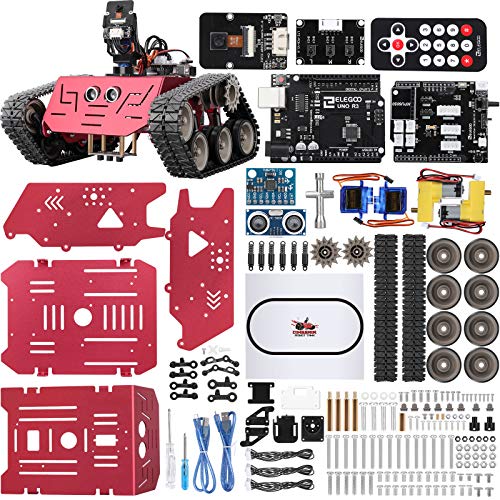
Based on Arduino, the ELEGOO Conqueror kit emphasizes open resources and rich learning materials. DIY assembly strengthens concentration and hands-on ability, while graphical programming introduces block-based functions that reveal car-like capabilities. The kit supports a range of project ideas, from basic motion to more complex robotic behaviors.
As a beginner-friendly platform, it helps learners bridge from simple tinkering to more advanced electronics and programming projects, with ample room for experimentation and customization as confidence grows.
ACEBOTT Smart Robot Kit with Camera and App Control

ACEBOTT combines a programmable ESP32 controller with compatibility for Arduino and Scratch. It includes a built-in 3MP camera for real-time streaming to a smartphone, enabling kids to learn image processing and robotics from a first-person perspective. The kit comes with story-based tutorials to guide beginners through assembly and coding steps.
The modular design supports expansions like a robotic arm and solar panel (sold separately), allowing continued growth beyond initial builds. This kit is well-suited for curious learners who want integrated hardware, software, and multimedia components in one package.
Buying Guide
- Skill progression: Look for kits that start with simple builds and gradually add coding complexity, so beginners can grow confidence without frustration.
- Programming path: Consider whether a kit provides block-based coding (easy for beginners) and whether it also supports Python or Arduino for future expansion.
- Hardware expandability: Choose kits with modular components, multiple models, or upgrade options to extend learning over time.
- Support and tutorials: Favor kits with clear instructions, tutorials, and a large community or official resources for troubleshooting and ideas.
- Power and control options: Assess whether the kit uses batteries, USB, or solar power, and whether control is via remote, app, or computer, depending on preference and environment.
- Safety and age appropriateness: Verify that the kit is designed for the target age group and includes safe, non-toxic components and age-appropriate small parts.
- Learning outcomes: Consider how the kit addresses core STEM concepts such as electronics, mechanics, programming, problem solving, and systems thinking.
- Budget and value: Evaluate the number of models, piece count, and included sensors or modules to gauge long-term value beyond initial playtime.