Parents and educators seeking engaging, hands-on STEM experiences will find a range of robot kits tailored for kids. The following selections emphasize solar power, remote control, and beginner-friendly coding to foster curiosity, problem-solving, and practical engineering skills. Each kit supports screen-free play or gentle tech exposure, making them suitable for a wide age range and classroom use.
| Product | Brand | Key Feature |
|---|---|---|
| Sillbird 12-in-1 Solar Robot Building Kit | Sillbird | Solar-powered, 12 build options, outdoor learning |
| Bottleboom 13-in-1 Solar Robot Kit | Bottleboom | 13 models, water/land mobility, non-toxic parts |
| Lucky Doug 12-in-1 Solar Power Kit | Lucky Doug | 12+ models, sun-powered, beginner-friendly |
| Henoda 468+ Piece Robot Kit | Henoda | Large brick-style build, multi-mode control |
| Sillbird Remote-Control Robot Kit | Sillbird | 5-in-1, app and remote control, programmable |
This article highlights five well-rounded options that align with common beginner-to-intermediate learning goals: exploring renewable energy, understanding mechanical assembly, and introducing basic programming and control concepts. Each entry includes a brief overview, core features, and how it supports skill development, with a practical buying guide at the end for quick comparison.
Sillbird 12-in-1 Solar Robot Building Kit

Features include a solar-powered design that encourages outdoor play and off-screen exploration. The kit supports multiple builds, enabling kids to redesign and experiment with different mechanisms, reinforcing problem-solving and engineering concepts. It appeals to ages 8-13 with a focus on renewable energy education and hands-on assembly. The sun-powered operation can be supplemented with indoor light for continued play, keeping kids engaged across environments.
Bottleboom 13-in-1 Solar Power Robots

This kit offers 13 build-and-rebuild options, with components that support land and water mobility. Included parts such as gears, plates, tires, and shafts provide a robust engineering experience. Parts are designed for safe play with non-toxic ABS materials and smooth finishes. It emphasizes solar energy use and invites children to explore basic engineering principles while managing assembly complexity with step-by-step guidance.
Lucky Doug Solar Power Kit
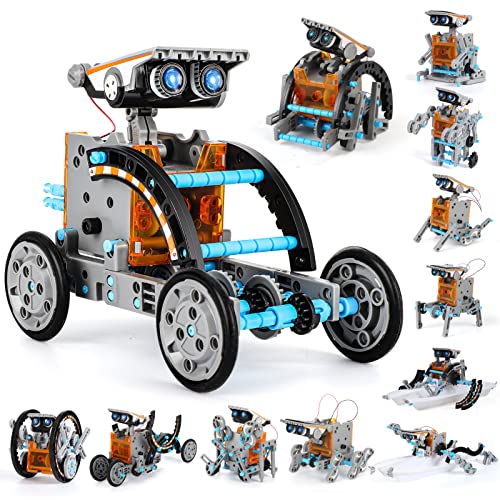
Featuring 12+ models, this solar-driven kit teaches concepts of energy, propulsion, and simple machine design. Clear instructions aim to simplify assembly, making it approachable for children aged 8-12 and up to early teens. The sun-powered design encourages kids to experiment with renewable energy experimentation while building confidence in problem-solving as they assemble and reassemble different robot configurations.
Henoda Robot Kit With 468+ Pieces
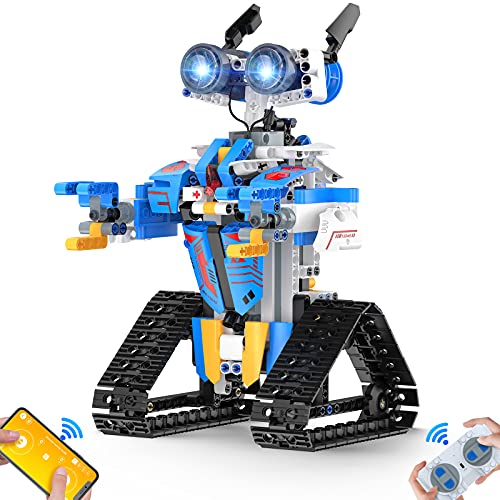
This brick-style robotics kit blends building blocks with STEM concepts, offering 468+ pieces and a range of modes. It supports hands-on construction, fine motor development, and imaginative play. The kit provides remote and app-based control, including multiple modes such as path, voice, and gravity-sensor capabilities. It’s a substantial option for 8- to 16-year-olds seeking advanced building and programmable play.
Sillbird 5-in-1 Remote-Control Robot Kit

This 5-in-1 programmable robot set blends hands-on building with both Bluetooth app and remote control. It emphasizes basic programming and precise movement through an intuitive control system, offering flexible engagement for kids who are ready to deepen their coding and robotics understanding. The dual-control option supports varied play styles and learning paces.
Buying Guide
- Age appropriateness: Look for kits labeled for the child’s age range. Solar-powered sets typically suit younger children with straightforward assembly, while brick-style and RC kits suit older kids and early teens seeking more complex builds and programming.
- Power source: Solar-powered kits promote renewable energy concepts and outdoor play, while some kits rely on batteries or electronic controls. Consider the environment in which the child will play most.
- Learning goals: Match the kit to goals like engineering fundamentals, coding basics, or problem-solving. Some kits emphasize construction and manipulation of moving parts; others focus on programming and app-based control.
- Build complexity: Start with simpler 2–3 model kits if the child is new to robotics. Progress to multi-model or programmable sets to progressively challenge skills and sustain interest.
- Safety and materials: Check for non-toxic materials and rounded edges. ABS plastic is common and generally durable for kid-friendly builds.
- Expandability: Consider kits that offer additional models or accessories. A modular kit supports continued learning as skills grow.
- Community and support: Look for kits with clear instructions, online tutorials, and customer support. This helps with troubleshooting and sustaining engagement.
Across these selections, buyers can compare the balance between simplicity and challenge, the use of solar power versus electronic control, and the potential for future learning through expansion and programming. Each kit provides hands-on experiences that translate to core STEM competencies, from engineering reasoning to basic coding concepts and system thinking.