Exploring robotic arm kits can be a great way for adults to dive into hands-on engineering, coding, and automation. This guide highlights five robust options that balance mechanical sophistication with accessible programming, allowing hobbyists and makers to prototype gripping, picking, and manipulating objects. Each kit offers a distinct path—from open-source Arduino integration to Raspberry Pi compatibility—so readers can choose based on hardware familiarity, expandability, and learning goals.
Summary of chosen products:
| Product | Brand | Key Focus | Typical Use | Link |
|---|---|---|---|---|
| Robotic Arm Kit 6DOF with 5 Servos | LewanSoul | 6DOF, PC software control, tutorials | Creative projects, education, prototyping | View |
| Robotic Arm Kit with Arduino 5DOF | LewanSoul | Arduino compatibility, open source | Programming practice, secondary development | View |
| ACEBOTT Smart Robot Arm Kit | ACEBOTT | ESP32 control, 5DOF, app & tutorials | Coding, real-time control, STEM learning | View |
| Thames & Kosmos Bionic Robotic Arm | Thames & Kosmos | Cable-driven, no batteries required | Mechanical robotics exploration, problem solving | View |
| BLONWINER Smart Robot Kit With Raspberry Pi | BLONWINER | Raspberry Pi compatibility, camera, sensors | Projects with Python and Pi, learning robotics | View |
LewanSoul Robotic Arm Kit 6DOF
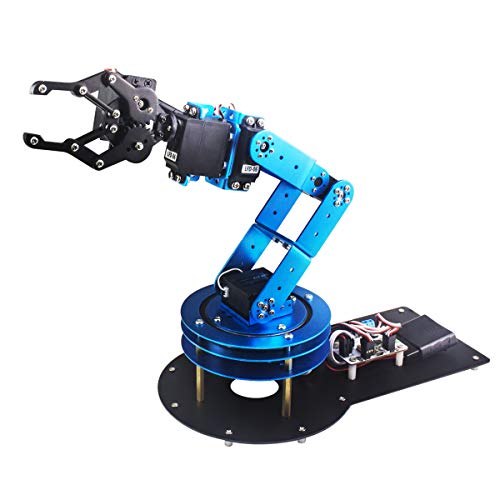
The LewanSoul LeArm is a 6DOF desktop robotic arm featuring six high-quality digital servos and a robust metal frame. It supports remote control, object transportation, custom actions, and graphical programming via PC software and tutorials. The design emphasizes stability with a fortified base and high-torque servos, making it suitable for adults pursuing hands-on robotics projects and demonstrations. Anti-stall protection helps extend servo lifespan, supporting longer practice sessions and experimentation.
Key considerations for adults: system expandability, software compatibility, and build quality. The combination of mechanical strength and programmable control enables learners to explore kinematics, pick-and-place tasks, and basic automation sequences. The inclusion of tutorials helps new users ramp up quickly while still providing room for advanced experimentation and custom code development.
LewanSoul Arduino 5DOF MiniArm Kit

The Arduino-based miniArm emphasizes open-source hardware and software, built on the Atmega328 platform. Its 5DOF configuration and multiple expansion ports enable sensor integration, Bluetooth, and potential ESP32 or other module add-ons. The kit supports app control and real-time knob-based adjustments, making it a practical choice for learners who want to prototype with Arduino, explore robotics software, and later transition to more complex projects.
Adults considering this option should note the balance between hardware simplicity and expandability. While it provides a solid foundation for programming practice and behavior customization, it may require additional accessories or sensors for advanced tasks. Its open-source ecosystem encourages experimentation and secondary development, which is ideal for ongoing learning and portfolio building.
ACEBOTT 5DOF ESP32 Smart Robot Arm

The ACEBOTT kit centers on an ESP32 controller with 5DOF, offering app-based control and 16 guided tutorials. It emphasizes beginner-friendly assembly while delivering opportunities for secondary development through coding in Python or Arduino-compatible environments. The kit supports real-time control, object grabbing, and expandable features, aligning with learners who want to practice robotics programming, test automation concepts, and explore sensor integration as they advance.
From an adult perspective, the combination of a capable microcontroller, guided tutorials, and expandability into sensors or additional hardware makes this kit well-suited for practical projects, R&D prototypes, or college-level hobby work. It provides a clear entry point into modern embedded robotics and coding workflows.
Thames & Kosmos Bionic Robotic Arm

This Thames & Kosmos project presents a cutting-edge, cable-driven robotic arm assembled from nearly 300 pieces. It requires no motors or batteries; instead, joysticks manipulate a nylon cable network to achieve precise movement. The arms and claw open, close, and rotate using the joystick controls, offering a tactile, mechanical approach to robotics that emphasizes linkages, timing, and coordination. It’s a strong fit for adults seeking a hands-on, mechanical engineering challenge and cooperative building experiences.
Design considerations for adults include the emphasis on manual control mechanics, the educational focus on cable-pulley systems, and the lack of motors. This kit is ideal for demonstrating core robotics principles without electrical complexity, while still delivering meaningful, observable results and a satisfying building challenge.
BLONWINER Raspberry Pi Robotic Arm Kit

The BLONWINER kit supports Raspberry Pi integration, enabling Python-based control and camera-enabled projects (Pi board not included). It features a two-in-one robot car kit with a programmable arm, real-time camera display, color tracking, line tracing, obstacle avoidance, and RGB lighting. This bundle is suitable for learners who want to connect robotics with computer vision and Pi-powered projects, ideal for adults pursuing more advanced, multi-threaded projects and creative coding challenges.
Buying Guide: Key Purchase Considerations
- Control architecture: Decide between Arduino-based, ESP32, or Raspberry Pi ecosystems. Arduino offers simplicity and portability, ESP32 adds Wi-Fi/Bluetooth, and Raspberry Pi enables more computational tasks like vision or advanced software stacks.
- Mechanical design: Assess the number of DOF, build materials (metal vs. plastic), and end-effector options (gripper, suction, etc.). Higher DOF and robust frames support more complex tasks but add complexity.
- Programming and tutorials: Look for kits with open-source software, available tutorials, and community support. A strong learning path helps justify the investment for self-directed projects.
- Expandability: Consider future upgrades such as additional sensors, cameras, or motor modules. A modular design sustains long-term interest and learning.
- Safety and reliability: Anti-stall protection, motor torque limits, and sturdy bases prevent premature wear and reduce frustration during experiments.
- Project goals: If the aim is education and demonstrations, a kit with clear experiments and visual feedback may be preferable. For prototyping, focus on software capabilities and hardware expandability.
- Age appropriateness: Some kits target younger learners; for adults, prioritize precision, control fidelity, and debugging potential to avoid oversimplified experiences.
- Budget and time: More capable kits require time to assemble and program. Plan for a realistic timeframe and consider whether you prefer a ready-to-run setup or a hands-on build.