Explore engaging, age-appropriate science kits that bring classroom concepts to life for elementary learners. From water quality and geology to robotics and experiments, these kits support curiosity, critical thinking, and hands-on discovery. The following selections are carefully chosen for accessibility, safety, and educational value.
Summary of Selected Products
| Product | Brand |
|---|---|
| 4M Clean Water Science – Climate Change Kit | 4M |
| The Everything Kids’ Science Experiments Book | Simon & Schuster |
| Carson Dellosa STEM Challenges | Carson Dellosa Education |
| 5 Set Individual STEM Kit for Kids | BeAndge |
| STEM Toy Rock Science Kit Geology | Toysmith |
4M Clean Water Science Kit—Climate Change Education

The 4M Clean Water Science kit introduces elementary learners to desalination concepts and the science behind freshwater resources. This hands-on kit demonstrates a practical method to extract salt from seawater using a simple filtration sequence. It includes a plastic filter system, active carbon, sand, rock, and filter paper to visualize filtration stages and adsorption processes. The kit’s activities are designed to engage curious minds in chemistry and environmental science while reinforcing steps of a controlled experiment, data collection, and observation.
Educational value centers on environment and chemistry basics, with age-appropriate experiments that explain why clean water matters and how scientists test water quality. The components support guided exploration and can be used to discuss climate change implications, water conservation, and the science of filtration. Safety notes and clear instructions help young scientists complete the activities with minimal adult supervision, making it suitable for classroom demonstrations or at-home STEM time.
The Everything Kids’ Science Experiments Book
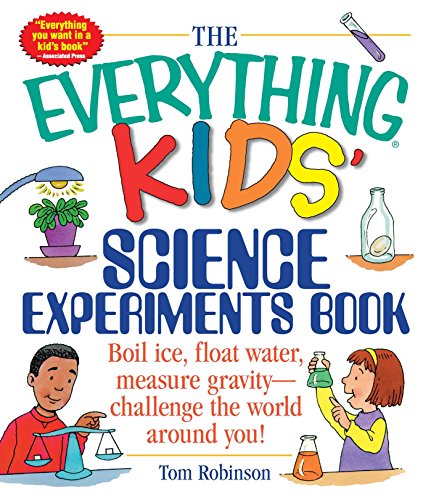
This comprehensive guide offers a broad range of experiments suitable for elementary students, encouraging experimentation and inquiry. The book covers topics such as chemistry, physics, biology, and earth science through engaging, kid-friendly activities. Each experiment includes materials lists and step-by-step instructions, plus explanations of the science behind the results. The accessible format and clear illustrations make it an excellent companion for science notebooks, classroom centers, or weekend STEM projects.
Key strengths include scalability for different skill levels, opportunities to compare observations over time, and prompts that invite kids to hypothesize, test, and revise. Teachers and parents can use it to structure science fairs, family science nights, or core science units. The content emphasizes critical thinking, documentation, and the joy of discovery, helping students build a solid foundation in scientific literacy.
Carson Dellosa STEM Challenges

Carson Dellosa’s STEM Challenges kit provides a curated collection of activities spanning physical, life, earth, and space sciences. Designed for learners aged 8-12 (roughly 3rd grade and up), the program uses 30 cards that present diverse topics with straightforward directions, needed materials, challenges, and helpful hints. Each card includes an exploration prompt, fostering hands-on problem solving, observation, and collaboration. The compact 7¾ x 5½ inch cards fit into a box with a divider for neat storage, making it ideal for classrooms, after-school programs, or family learning sessions.
What sets these challenges apart is their emphasis on inquiry and critical thinking. Students work through real-world scenarios, discuss findings, and develop an evidence-based approach to solutions. The guided structure helps teachers differentiate instruction and supports independent learners who enjoy tackling new problems. The set’s portability also makes it suitable for quick STEM warm-ups or extended project work.
5 Set Individual STEM Kit for Kids

This bundle offers multiple wind-powered car kits designed for children ages 6-12, packaged with complete accessories and a dedicated screwdriver to facilitate assembly. The kits introduce fundamental concepts in science, technology, engineering, and mathematics through hands-on building and experimentation with wind-powered mechanisms. They are suitable for classroom activities, science fairs, or home projects, encouraging iteration, troubleshooting, and creativity as kids explore energy conversion and motion.
While the set provides a varied range of wind-powered designs, it requires basic batteries or power inputs that are not included. Educational considerations focus on constructing a simple system, testing performance, and comparing outcomes across different configurations. The eco-friendly materials and safety-focused design support constructive, mess-light experimentation that aligns with elementary-level STEM curricula.
STEM Toy Rock Science Kit Geology
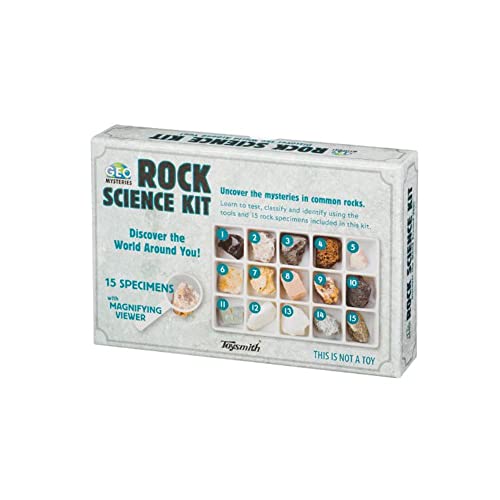
The Rock Science Kit introduces young geologists to identifying and classifying rocks through testing and observation. The package includes fifteen rock specimens, a magnifying viewer, and an identification guide to help students compare textures, colors, and mineral properties. This hands-on kit emphasizes geology fundamentals, including rock cycles, sedimentary processes, and mineral identification, while encouraging careful observation and data recording.
Educational value lies in building scientific vocabulary, developing data collection habits (noting observations, hypotheses, and conclusions), and promoting curiosity about Earth sciences. The kit is well-suited for classroom centers, science clubs, or independent study. It also provides a concrete way to link outdoor observations with lab-style analysis, helping students connect fieldwork to laboratory thinking.
Buying Guide: Key Purchase Considerations
Age-Appropriate Difficulty
Choose kits with clear age guidance and modular activities that scale with a child’s progress. Look for resources that offer easier starter experiments with progressively challenging extensions to maintain engagement as skills grow.
Scientific Focus and Alignment
Match kits to core science domains your child is exploring—chemistry, physics, earth science, or engineering. Kits that tie into school standards can reinforce classroom learning and support homework or project work.
Hands-On Value and Safety
Prioritize kits with durable materials, clearly labeled safety instructions, and tools appropriate for children’s ages. Hands-on experiences should foster observation, hypothesis testing, and iterative thinking without excessive supervision.
Materials Accessibility
Consider whether components are easy to find, affordable, and compatible with household items. Some kits include all necessary parts, while others require a few common supplies, which can affect long-term usability and cost.
Storage, Organization, and Reusability
Look for compact storage solutions and organized task cards. Reusable components or repeatable experiments add long-term value and support ongoing curiosity beyond a single activity.
Educational Value and Engagement
Evaluate whether the kit encourages inquiry, careful documentation, and discussion of findings. Kits that prompt questions, encourage collaboration, and invite kids to explain their reasoning tend to deliver deeper learning outcomes.
Supplementary Learning
Some kits pair with books, online content, or teacher guides. Supplemental resources can boost literacy, vocabulary, and science communication skills, while also providing structured lesson planning ideas for educators.
In selecting science kits for elementary students, prioritize a mix of exploration, explanation, and evidence-based activities. The highlighted options provide varied approaches—from environmental science and geology to robotics and engineering—helping young learners build foundational science literacy and a lasting curiosity about the natural world.