High school science benefits from engaging, hands-on kits that reinforce concepts in electricity, magnetism, chemistry, and engineering. The following selected kits are designed to support classroom learning or independent study for teens, with clear guides, materials for multiple experiments, and 3D models or real lab tools. Each option emphasizes safe, structured exploring of core concepts, enabling students to think critically and apply theory to real-world scenarios.
| Product | Brand | Key Focus | Contents Snapshot |
|---|---|---|---|
| EUDAX School Physics Labs Basic Electricity Discovery Circuit and Magnetism | EUDAX | Electricity & Magnetism fundamentals | 56 electricity items, 21 magnetism items, color manual, storage bag |
| LINKTOR Chemistry Molecular Model Kit (444 Pieces) | LINKTOR | 3D molecular structures, stereochemistry | 444 pieces, 136 atoms, 158 bonds, fullerene set |
| Thames & Kosmos Chem C3000 (V 2.0) Chemistry Set | Thames & Kosmos | Advanced chemistry experiments & lab work | 333 experiments, 192-page manual, professional equipment |
| National Geographic Stunning Chemistry Set | National Geographic | Intro to chemistry with fun experiments | 45 easy experiments, kid-friendly guide |
| Thames & Kosmos Chem C1000 Chemistry Set | Thames & Kosmos | Beginner to intermediate chemistry lab work | 125 experiments, 80-page lab manual |
The following sections spotlight five high school–oriented kits that balance depth, safety, and classroom-ready activities. Each section includes a direct link to Amazon for quick purchase, an image for visual reference, and a concise summary of what makes the kit valuable for learning outcomes.
EUDAX School Physics Labs: Basic Electricity & Magnetism
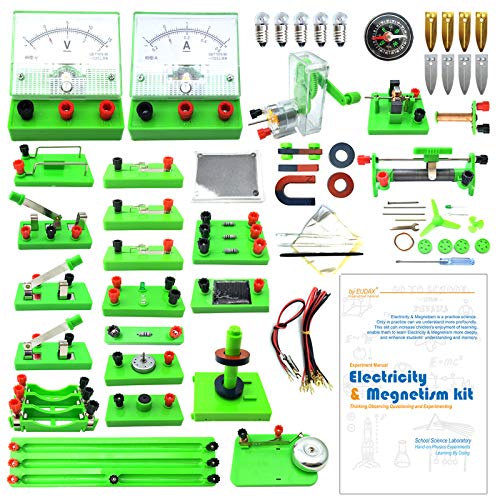
The EUDAX kit provides a hands-on introduction to electricity and magnetism for high school students in grades 9–11. It includes a color-page manual and a broad assortment of components to build simple electrical and magnetic models, enabling learners to connect theoretical concepts with tangible experiments. The set comprises 56 electricity items, 21 magnetism items, and a small repair tool set, all stored in a portable bag. Batteries are not included, and 3 AA cells are required to operate applicable experiments.
LINKTOR Chemistry Molecular Model Kit (444 Pieces)

The LINKTOR kit is designed for students from middle school through graduate level, offering extensive 3D representations of molecules. With 444 pieces, including 136 atoms and 158 bonds plus a fullerene set, learners can build ball-and-stick and space-filling models. The kit supports demonstrations of molecular geometry, bond angles, and stereochemistry, making abstract concepts concrete and interactive.
Thames & Kosmos Chem C3000 (V 2.0) Chemistry Set

The Chem C3000 is designed for serious learners who want to explore a wide range of chemistry topics. It includes high-quality lab equipment such as test tubes, beakers, flasks, plus numerous chemicals to perform over 333 experiments. The kit covers chemical equations, atomic structures, and bonding, offering a robust pathway to deeper chemistry mastery for high school students.
National Geographic Stunning Chemistry Set

The National Geographic chemistry set combines education with engaging activities. It features 45 experiments that range from building a volcano to launching a rocket, designed for kids and teens to explore reactions and scientific methods. The kid-friendly instruction guide includes illustrations and insights into chemical processes, helping students understand concepts while remaining accessible and fun.
Thames & Kosmos Chem C1000 Chemistry Set

The Chem C1000 set targets beginner to intermediate chemistry learners with 125 experiments and an 80-page lab manual. It supports safe handling of cell chemistry concepts, solution preparation, reaction observation, and standard lab techniques. The professional-grade equipment helps students explore chemistry outside the kitchen while building foundational laboratory skills.
Buying Guide: Key Purchase Considerations
- Curriculum alignment: Look for kits that map to core high school concepts in electricity, magnetism, organic and inorganic chemistry, and chemical reactions. Consider whether the kit supports project-based learning or structured lab activities.
- Safety and supervision: Prioritize kits with clear safety guidelines, age recommendations, and included PPE or safe handling procedures. For younger teens, ensure activities are age-appropriate and require teacher or guardian oversight where necessary.
- Materials and durability: Check the quantity and quality of components, storage solutions, and whether the kit includes reusable tools. A well-organized set minimizes setup time and maximizes hands-on learning.
- Instructional depth: Compare manuals and digital resources. Kits with detailed explanations, diagrams, and experiment logs help students build scientific reasoning and documentation habits.
- Modeling and visualization: Molecular kits and structural chemistry sets are valuable for visualizing abstract ideas like bond angles and molecular geometry. These can complement textual learning and improve retention.
- Scalability: Consider whether the kit can support multiple students or extended projects. Some sets include many experiments, enabling ongoing exploration beyond initial lessons.
- Budget and value: Higher-end sets often provide broader topic coverage but cost more. Balance the number of experiments, quality of equipment, and the relevance to your course or personal study goals.
- Teacher resources: For classroom use, availability of teacher guides, student worksheets, and assessment ideas can reduce preparation time and enhance learning outcomes.