Discover top science toys that captivate six-year-olds with hands-on experiments, safe materials, and clear instructions. This guide highlights kits that promote curiosity, critical thinking, and problem-solving while keeping learning fun. Each selection offers engaging activities, age-appropriate challenges, and opportunities for screen-free play. Read on to explore five standout options that align with early STEM development and everyday discovery.
| Product | Brand | What It Promotes |
|---|---|---|
| Doctor Jupiter My First Science Kit | Doctor Jupiter | 100+ experiments, critical thinking, hands-on learning |
| National Geographic Light Up Terrarium Kit | Blue Marble | Plant growth, observation, science visualization |
| Creativity for Kids Grow ‘N Glow Terrarium | Creativity for Kids | Terrarium building, nighttime glow, biology basics |
| National Geographic Magic Chemistry Set | Blue Marble | Hands-on chemistry, safe experiments, science magic |
| National Geographic STEM Kit | Blue Marble | Crystal growing, volcano, dig kits, geoscience |
Doctor Jupiter My First Science Kit

This kit offers a broad introduction to scientific inquiry for kids ages 4–8, featuring more than 100 experiments to spark curiosity. It emphasizes STEM concepts by inviting children to observe, ask questions, and test ideas, helping to build problem-solvers through engaging, hands-on activities. The kit is designed to be a practical gateway into laboratory-style exploration without screens, suitable for birthdays, holidays, or everyday learning.
National Geographic Light Up Terrarium Kit

The terrarium kit lets kids create a small dinosaur habitat using real plants and gemstones. Its wide-mouth design makes setup easy for little hands, and the USB-powered light helps sustain nighttime viewing without batteries. This kit blends biology, ecology, and imaginative play as children plant seeds, observe growth, and customize their prehistoric scene, making it a strong choice for curious minds who enjoy visual learning.
Creativity for Kids Grow ‘N Glow Terrarium

This terrarium kit emphasizes a dual-stage project: build a living biotope during the day and enjoy a glow-in-the-dark display at night. It includes seeds and decorative elements to personalize the habitat, supporting basic botany concepts such as germination, plant care, and ecosystems. The glow feature adds a memorable, visual element that reinforces observational learning, making it appealing for kids who love arts and crafts as well as science experiments.
National Geographic Magic Chemistry Set
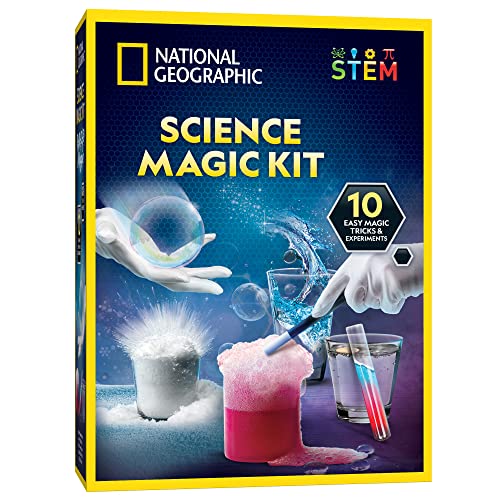
Designed to introduce chemistry through playful magic tricks, this kit offers 10 experiments that demonstrate chemical reactions in entertaining ways. The included wand and gloves enhance the performance aspect, making science feel like a magic show while still teaching real scientific principles. The illustrated guide supports independent learning and family demonstrations alike, helping kids connect everyday wonder with foundational chemistry concepts.
National Geographic STEM Kit

This kit bundles more than 15 activities, including a volcano model, crystal growth, and dig kits. It emphasizes a broad range of Earth and physical sciences, offering multiple activities that encourage collaboration and repeated experimentation. The included learning guide supports structured inquiry, helping children understand the science behind each activity while sharing discoveries with family and friends.
Buying Guide: Key Purchase Considerations
- Age-appropriateness: Look for kits tailored to ages 6 and up with clear, illustrated instructions. Some kits also support younger learners with simpler steps and larger components.
- Learning focus: Decide whether you want biology (terrariums), chemistry (reaction-based kits), physics (simple machines), or a broad STEM mix. A varied set can reinforce cross-disciplinary thinking.
- Safety and supervision: Choose kits with non-toxic materials and age-appropriate tools. Some experiments require adult supervision or assistance, especially for younger children.
- Durability and reusability: Reusable components and durable packaging extend the life of a kit, making it suitable for siblings or multiple uses.
- Educational value: Prefer kits with clear explanations, diagrams, and a learning guide that explains the science concepts behind the activities.
- Creative and exploratory balance: Kits that blend science with crafts or storytelling can sustain interest and turn learning into a fun, ongoing project.
- Value for money: Compare the number of experiments, the range of topics, and the quality of components to gauge long-term educational benefit.
- Encouraging collaboration: Some kits are designed for group play or family participation, which can reinforce teamwork and communication skills.
For parents seeking a well-rounded option, consider starting with a biology-themed terrarium to build observational skills, then pairing with a chemistry or physics project to broaden scientific exposure. These selections emphasize safe, engaging, age-appropriate activities that promote inquiry, experimentation, and sustained curiosity in science for six-year-olds.