Finding engaging STEM toys for eight-year-olds can spark curiosity and build confidence in science. The following picks focus on hands-on experiments, robotics, circuitry, and creative kits designed to educate while entertaining. Each option invites kids to explore core concepts in chemistry, biology, physics, and engineering through age-appropriate projects that emphasize observation, reasoning, and safe exploration.
| Product | Brand |
|---|---|
| National Geographic Magic Chemistry Set | Blue Marble |
| National Geographic Gross Science Kit | Blue Marble |
| STEM 13-in-1 Education Solar Power Robots | Bottleboom |
| Klutz Lego Gear Bots | Klutz |
| Snap Circuits Jr. SC-100 | Snap Circuits |
These five selections balance safety with challenge, offering experiments that are visually appealing, conceptually clear, and expandable with additional activities at home or in a classroom. By presenting a mix of chemistry, electronics, robotics, and mechanical engineering, this list supports varied interests and helps kids see how different branches of science connect.
National Geographic Magic Chemistry Set
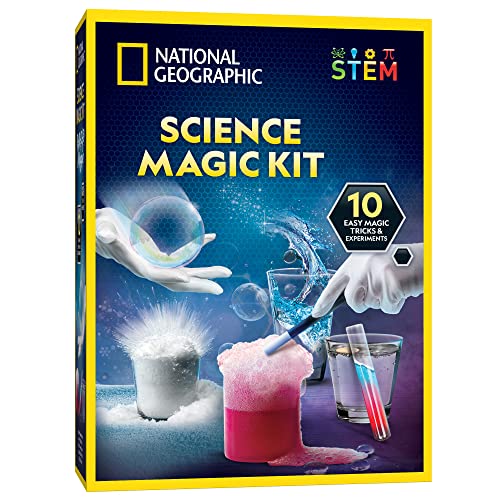
The Magic Chemistry Set invites kids to perform ten science experiments that double as magic tricks. Activities such as making a coin float and changing the color of water blend wonder with foundational chemistry concepts. Designed as a magic-themed kit, it includes a wand and white gloves to enhance role-play while learning, helping children narrate and document the science behind the tricks. The illustrated guide provides kid-friendly steps and explains the science in approachable terms, making it approachable for curious beginners who want to see science in action.
Features highlight a hands-on balance between spectacle and learning: visually engaging tricks, a companion guide with explanations, and the opportunity to demonstrate experiments to family and friends. This kit emphasizes safe, supervised experimentation and encourages kids to predict outcomes, observe results, and refine hypotheses in a playful context.
National Geographic Gross Science Kit

The Gross Science Kit centers on high-impact, memorable experiments that lean into the fun side of science. With activities described as “super gross”—from bubbling boogers to glowing worms—children explore biology and chemistry in a vivid, memorable way. The included experiment guide features illustrated steps and explanations that connect the gross results to underlying scientific ideas, while a bonus booklet expands exploration with additional experiments using common household items.
Prospective buyers should note the kit’s emphasis on engagement and shared discovery. It supports collaborative learning as kids compare results, discuss observations, and debate why certain materials react in surprising ways. While the theme is playful, the kit also reinforces safety practices and methodical thinking essential to credible science inquiry.
STEM 13-in-1 Solar Power Robots

This solar-powered robot kit lets kids build up to 13 different robots, including land and aquatic models, all driven by solar energy. The modular design teaches core engineering principles—gears, plates, tires, shafts—and emphasizes problem solving as children disassemble and reassemble to create new configurations. Built with non-toxic ABS materials, the kit prioritizes safety while encouraging hands-on experimentation with solar energy as a power source, reinforcing sustainable thinking from an early age.
Educational value emerges through guided builds and open-ended play: kids can follow the manual to achieve specific models or experiment freely to test ideas about motion, energy transfer, and mechanism interplay. This kit suits learners who enjoy iterative design challenges and who benefit from clear, tangible demonstrations of robotics concepts.
Klutz Lego Gear Bots

The Klutz Lego Gear Bots activity kit combines LEGO Technic pieces with papercraft to create eight kinetic creatures powered by axles, cams, and gears. The included 64-page book weaves STEM content into a hands-on project, delivering step-by-step instructions and explanations of engineering concepts as kids build and adjust their models. This kit blends construction play with mechanical reasoning, helping children understand timing, movement, and how complex systems arise from simple parts.
For parents and educators, the kit offers a practical way to introduce engineering vocabulary and design thinking. It supports cooperative learning when children collaborate on assemblies or explain their mechanisms to peers, which reinforces communication skills alongside STEM basics.
Snap Circuits Jr. SC-100

The Snap Circuits Jr. kit introduces basic electronics through more than 100 project ideas, all built from a modular, snap-together system. The colorful instruction manual guides kids through projects that illustrate circuits, switches, and power sources while fostering hands-on experimentation. This kit is well-suited for eight-year-olds who enjoy troubleshooting, problem solving, and seeing immediate, visible results from their wiring and component choices.
As projects scale in complexity, children develop a practical understanding of circuitry concepts and safety practices. The modular nature enables parents to gradually increase challenge, while the broad range of possible builds encourages creativity and experimentation within a structured learning framework.
Buying Guide: Key Purchase Considerations
- Age-appropriateness: Look for kits labeled for ages 8-12 to match capability without overwhelming complexity. Consider where your child is on the curiosity spectrum—newcomers may prefer kits with strong guiding instructions, while advanced young learners may enjoy open-ended projects.
- Safety and materials: Check for non-toxic components, rounded edges, and clear safety guidelines. ABS plastics and kid-friendly solvents are common in reliable kits.
- Core science focus: Decide which STEM domains interest your child—chemistry, electronics, robotics, or physics-based engineering—and choose a kit that emphasizes those areas while offering some breadth for exploration.
- Instruction quality: Strong, illustrated guides help young learners follow steps and understand the underlying science. Look for explanations that connect activities to real-world concepts.
- Scalability: Options that allow iterative building or expansion are valuable for sustained engagement. Consider kits that can be supplemented with additional projects or compatible accessories.
- Materials safety and durability: Reusable components and robust construction reduce wear and increase long-term value. Verify that parts assemble securely and are designed for repeated use.
- Social and cooperative play: Some kits support group learning, which can help kids develop collaboration and communication skills while exploring scientific ideas together.
- Cost and value: Compare not just upfront price but also the breadth of projects, potential for future play, and included learning resources to determine overall value.
- Storage and organization: Kits with clear component bins or organizers simplify cleanup and encourage ongoing exploration without chaos.