Finding engaging, safe gear that supports sensory development and motor skills can be challenging. The following 5 products are selected for diverse sensory experiences, from swinging and wobbling to climbing and balancing. Each option fosters balance, coordination, tactile exploration, and spatial awareness in kids of various ages, making them suitable for home playrooms and classrooms alike.
Quick reference — Chosen products for sensory play and motor development:
- Simplay3 Two Sided Rock Around Wobble Disk and Climbing Dome
- Aokitec Sensory Swing for Kids
- Upgraded Indoor Playground 9-in-1 Jungle Gym
- Wingyz Pikler Triangle Climbing Set
- Gym1 6-Piece Doorway Gym Indoor Playground
Simplay3 Two Sided Rock Around Wobble Disk

The Simplay3 wobble disk features a rock-and-climb design that grows with a child’s abilities. Its bowl-shaped seat includes molded-in grip handles to support early balance and coordination. Flipping the disk transforms it into a two-sided play structure—still light enough for indoor and outdoor use. This versatility makes it a practical centerpiece for sensory exploration, enabling toddlers to practice core stability and gross motor skills while transitioning between rocking and climbing activities. The product’s indoor/outdoor versatility supports year-round active play.
Aokitec Sensory Swing For Kids

The Aokitec sensory swing provides a cocoon-like space that offers hug-like pressure, supporting calm and orientation for kids with sensory processing needs. Made from soft nylon, its dimensions accommodate comfortable seating while delivering a soothing, proprioceptive input. This cuddle hammock can aid in body awareness, balance, motor planning, and spatial skills, and its gentle motion supports repetitive, self-regulated activity. Suitable for children who benefit from controlled sensory experiences, the swing can become a focal point for therapeutic play in a structured environment.
Upgraded Indoor Playground 9-in-1 Jungle Gym

The BlueWood 9-in-1 indoor playground combines climbing rocks, a slide, swings, climbing nets, an upright ladder, monkey bars, and multiple rope and ladder options in one wooden structure. Its natural wood design aligns with Montessori-inspired environments and reduces electronic distractions. A sturdy B-support frame emphasizes stability, supporting a weight capacity of up to 485 lbs to accommodate growing children and multiple users. The versatile arrangement promotes imaginative play, problem-solving, and multi-sensory exploration through varied routes and textures.
Wingyz Pikler Triangle Climbing Set
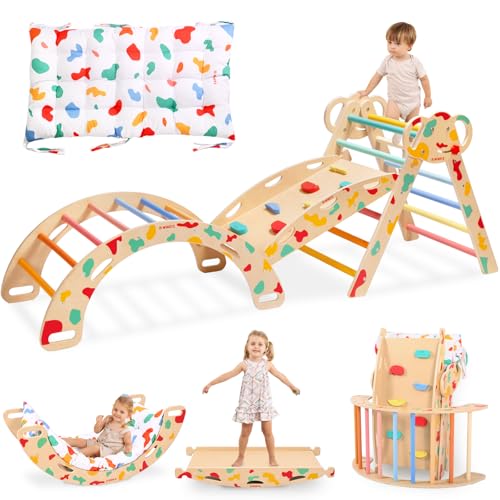
The Wingyz Pikler Triangle set focuses on Montessori-inspired active learning. It cultivates independence, balance, and coordination as children explore different climbable configurations. With dual-side high-definition animal imagery intended to boost cognitive development, the design emphasizes safety through a 2.35″ rung spacing to minimize entrapment risk. Ergonomically curved handles reduce grip fatigue, and the modular sections adapt to growing skills, enabling toddlers to gradually advance from basic pulls and crawls to more complex climbs, indoors or outdoors.
Gym1 6-Piece Doorway Gym Indoor Playground

The Gym1 doorway gym converts a doorway into a compact indoor playground, featuring a sensory swing, pull-up bar, rings, trapeze, ladder, and knotted rope. This setup provides a versatile circuit for upper body strength, fine motor control, and vestibular stimulation. Made to fit standard doorway frames, it can be installed quickly without permanent alterations. The inclusive design supports a range of ages with scalable challenges, enabling kids to practice coordination and spatial awareness through varied hanging and climbing tasks.
Buying Guide: Key Considerations for Sensory Play Equipment
- Age and safety: Choose equipment that aligns with the child’s age, size, and safety standards. Look for sturdy construction, rounded edges, and non-slip surfaces. Rung spacing and weight limits matter for safe progression.
- Type of sensory input: Consider the primary sensory benefits—proprioceptive input from swinging and climbing, vestibular stimulation from wobble and balance activities, and tactile exploration from textured mats or fabric hammocks.
- Space and setup: Measure available play space. Some pieces are modular or foldable, offering flexible layouts for small rooms and larger playrooms alike.
- Indoor vs. outdoor use: Confirm weather resistance and material suitability if planning outdoor use. Indoor playgrounds typically emphasize quiet, controlled environments, while outdoor options offer greater vestibular variety.
- Maintenance and cleaning: Materials like wood and nylon fabrics vary in care needs. Check cleaning instructions and finish durability to maintain a safe play surface.
- Age progression: Opt for gear that adapts to a child’s growing abilities. Modular or multi-feature setups encourage long-term use without frequent replacements.
- Therapeutic value: For children with sensory processing differences, prioritize products with calming or organizing features, such as cocoon swings or stable wobble disks, while ensuring supervision.
- Budget and space efficiency: Weigh the cost against play value and the potential for multiple children to engage concurrently. Multi-function units may offer better long-term value in busy households.
- Installation: Some items require assembly or wall anchoring. Review included hardware and instruction quality to ensure safe, secure installation.
When selecting a sensory gym setup for kids, balancing safety, developmental impact, and family logistics is essential. The listed products offer a spectrum of input—rocking, swinging, climbing, and balancing—designed to support motor development and sensory integration while fitting typical American homes and classrooms.