Exploring our solar system is a fantastic hands-on learning activity for kids. The following five solar system model kits offer a mix of glow-in-the-dark features, motorized action, and DIY creativity, helping children visualize planets’ orbits, colors, and distances. Each option is suitable for curious learners ages roughly 5 and up, with activities that support STEM learning, coloring, painting, and project-display ideas for bedrooms or classrooms.
| Product | Brand |
|---|---|
| National Geographic Glow-in-The-Dark Solar System Model Kit for Kids | Blue Marble |
| Science Can Solar System for Kids | Science Can |
| 4M Solar System Planetarium | 4M |
| Educational Insights GeoSafari Motorized Solar System | Educational Insights |
| Nine Planets DIY Solar System Model for Kids | Little Jupiter |
National Geographic Glow-in-The-Dark Solar System Kit

The kit offers a glow-in-the-dark 3D solar system with movable arms for all eight planets and the sun. It is an all-inclusive set that includes six paint colors, glow accents, a brush, a palette, decals, and a poster with solar system facts. Kids can customize each planet and arrange the model to mirror their imagined orbits, making it a visually striking room decor piece as well as an educational project.
Science Can Solar System for Kids

This model projects the solar system’s eight planets onto any surface, turning ceilings into mini planetariums. It features bilingual educational content in English and Spanish and includes 24 space exploration image disks. The projector approach makes it ideal for classroom demonstrations or bedtime learning, with an easy switch between languages and a simple setup suitable for younger kids as well as older learners.
4M Solar System Planetarium
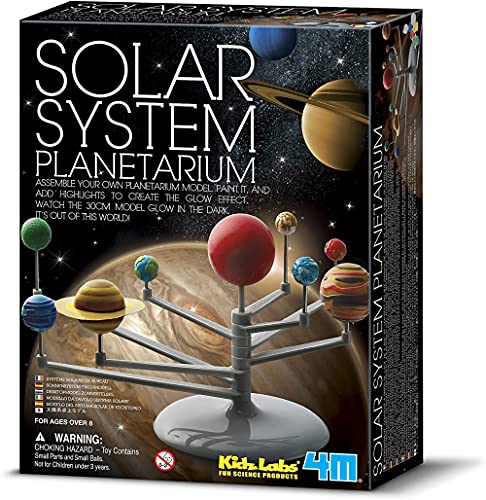
The 4M plan includes a hands-on build with glow-in-the-dark paints, stencils, rods, string, and a fact-filled wall chart. It also provides a set of Kidz Quiz questions to reinforce learning after assembly. This option emphasizes foundational astronomy concepts and display-ready results, suitable for homeschool projects or science fairs.
Educational Insights GeoSafari Motorized Solar System

This motorized model shows realistic planetary orbits around the sun with adjustable speeds, supporting STEM learning through hands-on exploration. The kit includes a star dome to project constellations, providing a dual experience of solar system motion and night-sky projection, plus an auto shut-off night-light feature to create a cozy learning atmosphere in any bedroom or classroom.
Nine Planets DIY Solar System Model

This kit targets school-age learners with a wood model, puzzle components, and fact cards. It supports multiple stages of learning—assembly, painting, and fact-based study—making it apt for science fairs, classroom displays, and bedroom decor while fostering a deeper understanding of the major planets.
Buying Guide
- Age suitability: Look for kits labeled for ages your child’s age group; some are beginner-friendly while others include more complex components for older kids.
- Learning style: Consider whether you want a hands-on build with paints and assembly, a projector-based experience, or a motorized model for motion and timing.
- Display considerations: If wall or shelf space is limited, choose compact models or those designed for desk-top display as opposed to large floor setups.
- Glow and projection features: Glow-in-the-dark paints and planetarium projectors enhance visibility in dim rooms; these are excellent for nighttime learning sessions but require charging or light exposure to glow well.
- Durability and materials: Foam, wood, and plastic components differ in weight, fragility, and repainting potential. Consider your child’s handling and cleanup needs.
- Educational content: Some kits include fact cards or poster sheets, while others emphasize interactive exploration or a narrative learning approach—evaluate which aligns with your goals.
- Expandable value: Some kits offer additional activities, posters, or disks; this can extend learning beyond the initial build and support ongoing curiosity about astronomy.
- Project timing: If you’re short on days, select kits with fewer pieces and quicker assembly; for longer-term projects, larger kits with more components can be more engaging.
Across these options, consumers can select a kit that aligns with a child’s interest in glow-in-the-dark science, orbit mechanics, or creative painting. Each product emphasizes core astronomy concepts, hands-on activity, and the potential for room decor that doubles as an educational display. When choosing, balance complexity with child interest, and consider whether a motorized or projection-based experience could better sustain engagement and curiosity over time.