Discover top-rated STEM toys designed for babies that promote hand-eye coordination, problem solving, and sensory exploration. These early-learning tools support development through grasping, stacking, sorting, and cause-and-effect play. Below are five carefully chosen products, each with engaging textures, colors, and safe materials to stimulate curiosity from infancy onward.
| Product | Brand | Age Range | Key Benefit |
|---|---|---|---|
| Sassy Stacks of Circles Stacking Ring | Sassy | 6+ Months | Fine motor skills and texture exploration |
| LiKee Montessori Toys for Baby | LiKee | 18+ Months | Motor skills and tactile variety |
| Baby Einstein Ocean Explorers Opus Go | Baby Einstein | 3 Months–5 Years | Gross and fine motor skills with music and lights |
| Fisher-Price Stacking Toy Blocks | Fisher-Price | 6+ Months | Sorting and stacking practice |
| Rainmaker Montessori Rainstick | PLAY | 6–12 Months | Sensory auditory development |
Sassy Stacks Of Circles Stacking Ring

The Sassy Stacks Of Circles includes nine chunky rings that fit onto a straight post. Each ring offers unique textures and weights, providing varied tactile input to support mouthing and exploration. The design encourages babies to grasp comfortably and align rings by size, promoting early problem-solving and hand-eye coordination. The textural diversity also helps with sensory development as little hands learn how different surfaces feel during play.
LiKee Montessori Toys For Baby

LiKee’s sensory travel toy uses pull-string mechanics to engage 18+ month toddlers in cause-and-effect play. When strings flow through to one side, children turn the toy over and start again, promoting extended engagement. Some strings are easy to pull while others present a challenge, supporting progressive fine and gross motor skills. The varied textures at the string ends offer rich tactile feedback, advancing sensory perception and hand coordination during interactive play sessions.
Baby Einstein Ocean Explorers Opus Go

The Ocean Explorers Go Opus Go is a versatile 4-in-1 crawl and chase activity toy with music and lights. It grows with the child, supporting development from infant to preschool stages. Modes include Tummy Time, Sit & Play, Chase, and Dance. Children learn numbers, shapes, colors, and opposites while refining listening skills and cause-and-effect understanding. With 150+ songs and phrases, Opus provides rich auditory and visual stimulation that supports motor planning and sequencing.
Toddlers Montessori Wooden Educational Toys

These wooden preschool toys center on shape sorting and color recognition, featuring 12 fruit blocks, 8 carrots, 10 worms, and a five-sided cart. The set emphasizes safety with large, polished pieces and non-toxic water-based paint. The variety supports fine motor skills, shape matching, color identification, and early problem-solving. Multiple game modes keep toddlers engaged while nurturing spatial reasoning and hand-eye coordination as they manipulate pieces and sort by shape or color.
Fisher-Price Stacking Toy Baby’s First Blocks

This set includes 10 colorful blocks designed for sorting, stacking, and dropping through a shape-sorter lid. All blocks store neatly inside a bucket, improving organization and portability for on-the-go play. The easy-carry handle supports independent exploration, teaching early geometry concepts and problem-solving as babies learn which shapes fit where and how high they can stack before tipping.
Rainmaker Rainstick Montessori Toy

The Rainmaker is a 7-inch wooden rattle that produces soothing rainfall sounds when shaken or rolled. It supports sensory development by providing clear auditory input and visual tracking as beads move through the translucent body. The easy-to-grasp tube is suited for young babies, helping to refine grabbing skills while introducing basic cause-and-effect concepts as the tones and motion respond to manipulation.
Aprilwolf Montessori Shape Block Toys
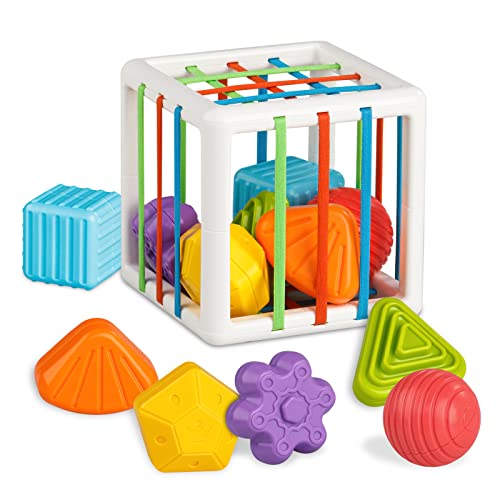
Aprilwolf offers a cube with six sensory shape blocks featuring different textures and elastic bands. This combination stimulates spatial reasoning and fine motor control as infants explore how blocks fit into the cube and how pulling and pushing motions influence outcomes. The inclusive design supports early STEM thinking by encouraging experimentation with shapes, textures, and spatial relationships.
Buying Guide
Key considerations when selecting STEM toys for babies include age suitability, material safety, and developmental goals. Look for non-toxic finishes, smooth edges, and pieces large enough to prevent choking hazards. Toys should encourage multi-sensory engagement—combining tactile textures, colors, sounds, and movement—to support motor skills and cognitive development. Consider how the toy scales with the child: does it offer progressively challenging tasks or modes? Assess portability for travel-friendly activities and the potential for shared play to promote social interaction. Finally, verify warranties or safety certifications when available and ensure the product aligns with your child’s current interests, such as stacking, sorting, or cause-and-effect play.
– Age range and developmental stage: choose toys appropriate for 6–18 months and beyond to grow with your child.
– Safety and materials: opt for FSC-certified wood, BPA-free plastics, and rounded edges.
– Usability: easy-grip shapes, clear visual cues, and intuitive mechanics support independent exploration.
– Sensory richness: textures, sounds, and bright colors engage attention and promote processing skills.
– Longevity and adaptability: consider modular toys with multiple play styles to extend use over months or years.