Parents and caregivers seeking engaging, age-appropriate activities for preschoolers can turn to STEM toys that build early science, technology, engineering, and math skills. This guide highlights five strong options that encourage hands-on exploration, fine motor development, problem solving, and collaborative play. Each product below includes a quick look at key features to help you choose the right fit for a curious young learner.
Summary Of Chosen Products
| Product | Brand | Key Benefit | Age Range |
|---|---|---|---|
| Kids STEM Building Toys | Qirptey | Creativity with large-piece blocks and an idea booklet | 3–8+ |
| Magnet Movers | Learning Resources | Early physics exploration with magnets | 5+ |
| Magnetic Building Blocks | COUOMOXA | Open-ended magnetic play for cognitive growth | 3–5 |
| Gears! Gears! Gears! | Learning Resources | Colorful gears for problem solving and motion | 3+ |
| Building Blocks 200 Pieces | TOMYOU | Versatile construction play with storage box | 3+ |
Kids STEM Building Toys For Early Learners

The 125-piece set from Qirptey offers a mix of colors and shapes that invite children to construct models such as race cars, robots, and trucks. An included idea booklet supports guided play while leaving room for imagination. The blocks help develop fine motor skills and early engineering concepts, making it a versatile option for home or classroom use. The open-ended design aligns with Montessori-inspired learning by encouraging independent exploration and collaborative building.
Magnet Movers Educational Magnet Set

Learning Resources’ Magnet Movers focuses on magnetism and early physics concepts for children ages five and up. This 39-piece set includes a magnetic wand, accessories, and an activity guide to spark curiosity about force, attraction, and motion. The kit supports hands-on experimentation, helping young learners observe cause-and-effect relationships while practicing problem solving and spatial reasoning.
COUOMOXA Magnetic Building Blocks

COUOMOXA’s 42-piece magnetic set introduces preschoolers to STEM through simple 2D and 3D structures. Its large pieces are designed for small hands, supporting color recognition, shape understanding, and fine motor development. The open-ended play aligns with Montessori-style learning and encourages independent exploration or shared activities with caregivers, promoting focus and spatial awareness.
Gears! Gears! Gears! Deluxe 100-Piece

This classic set from Learning Resources invites young builders to explore motion and cause-and-effect with colorful gears. The varied pieces promote critical thinking, problem solving, and fine motor skills while enabling kids to design moving experiments. The kit’s compatibility with other Gears! sets allows ongoing expansion as a child’s abilities grow.
TOMYOU 200 Pieces Building Blocks
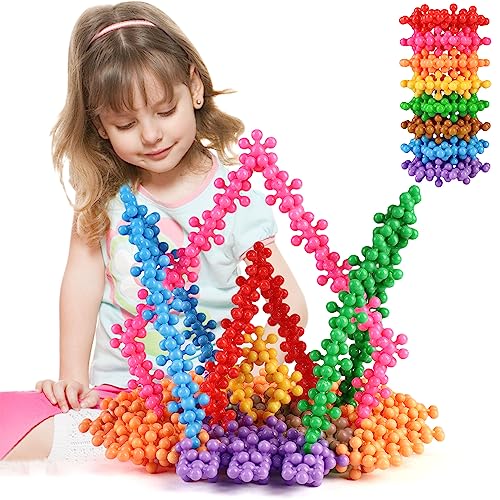
With 200 pieces in a bright palette, TOMYOU building blocks offer versatile construction play for ages three and up. The set supports STEM development by encouraging imagination, design thinking, and hands-on manipulation. A plastic storage box helps keep pieces organized for repeat play sessions and easy cleanup, making it a practical option for classrooms and homes.
Buying Guide for Preschool STEM Toys
Key purchase considerations help ensure you choose safe, engaging, and developmentally appropriate options for preschoolers.
- Age-appropriateness: Look for sets explicitly designed for ages 3–5 or 4–8 to match preschool developmental levels and safety standards.
- Open-ended vs. guided play: Open-ended sets (like magnetic tiles or blocks) foster creativity and flexible problem solving, while guided kits provide structured activities that build specific skills.
- Fine motor and spatial skills: Choose toys that require gripping, manipulating small parts, and arranging pieces to support dexterity and spatial awareness.
- STEM scope: Ensure the toy covers core STEM concepts suitable for preschoolers, such as simple mechanisms, magnets, gears, or basic engineering principles.
- Durability and safety: Prioritize sturdy materials, rounded edges, and BPA-free, lead-free components. Large-piece designs reduce choking hazards for younger children.
- Storage and organization: Sets with bins or boxes help with tidying up and encourage ongoing play sessions without clutter.
- Expansion potential: Some brands offer compatible add-ons, enabling longer play life as a child’s skills grow.
- Multi-child compatibility: Look for toys that support cooperative play or family involvement to promote social learning.
How To Choose For Your Child
For a child who loves building, consider a block-based set with a simple instruction booklet to scaffold creativity. If a child is curious about magnets or physical forces, magnet-based kits provide tangible demonstrations of attraction and repulsion. For families with limited space, compact sets with a storage solution offer convenient, repeatable play routines. Always supervise younger children with small pieces to ensure safe exploration, and rotate activities to maintain engagement over time.
Usage Scenarios And Learning Outcomes
Home playtime, classroom centers, and gift-giving occasions all benefit from STEM toys. Expect improvements in hand-eye coordination, pattern recognition, basic engineering concepts, and collaborative problem solving as children experiment with different configurations and models. Parents can extend learning by asking questions like “What happens if we add this piece?” or “How can we change the model to move differently?”