Finding the right toys for preschoolers means balancing learning with play. The following picks are designed to support early math, literacy, fine motor skills, and memory in engaging, kid-friendly ways. Each product below is chosen for durability, age-appropriateness, and educational value, making them great options for daily play, classroom activities, or gift-giving.
Summary of chosen products:
| Product | Brand | Use Case | Age Range |
|---|---|---|---|
| Preschool Learning Toys for Toddlers 2-4 | MOTREE | Counting, basic arithmetic | 3-5 |
| Magnetic Wooden Fishing Game | NASHRIO | Letters, numbers, color recognition | 3-5 |
| Go Fish Alphabet Game Cards | School Zone | Alphabet recognition, matching | 4+ |
| Hungry Hungry Hippos Game | Hasbro Gaming | Pure memory and speed competition | 4+ |
| Self-Correcting Alphabet Puzzle | Melissa & Doug | Letter recognition, vocabulary | 4+ |
Preschool Learning Toys For Counting And Math

The MOTREE Preschool Learning Toys emphasize early math concepts through manipulatives that children can see and touch. The kit includes a wooden finger board, 13 number blocks, 8 flash cards, and a holder. Designed to support counting, addition, and subtraction within 10, these tools help kids visualize arithmetic and strengthen fine motor skills. The Montessori-inspired approach encourages hands-on exploration, aligning with preschool curricula and home-school learning goals.
Why this toy works for preschoolers
Its tangible blocks and visual flash cards give kids a concrete way to grasp numbers, making abstract ideas more accessible. The setup encourages independent play as well as guided activities with adults, promoting confidence in early math skills without overwhelming instruction.
Magnetic Wooden Fishing Game For Alphabet And Numbers
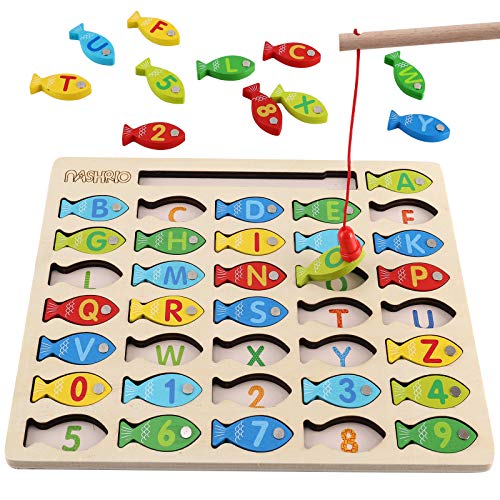
The NASHRIO Magnetic Wooden Fishing Game combines color recognition with letters and numbers. Children use a magnetic fishing pole to catch fish pieces, each marked with different letters or numbers. This interactive toy supports early literacy and math practice while developing hand-eye coordination and fine motor skills. The wood is polished with eco-friendly, non-toxic dye, providing a safe play experience for curious preschoolers.
What makes it engaging for preschoolers
Tabs of color and the challenge of fishing for the correct letter or number add an enjoyable, game-like aspect to learning. The repeated action of catching and sorting reinforces memory and recognition in a low-stress setting that is ideal for early learners.
Go Fish Alphabet Game Cards

School Zone’s Go Fish Alphabet Game Cards blend classic matching gameplay with alphabet learning. Suitable for preschool and kindergarten, these cards help children recognize uppercase and lowercase letters, build vocabulary, and practice word-picture associations. The set features bold letters and vibrant animal illustrations to sustain attention and curiosity during family game night or small-group classroom activities.
Educational benefits
Beyond letter recognition, kids practice memory, sequencing, and social skills through turn-taking and crisp, concise instructions. The familiar Go Fish format keeps expectations clear, reducing frustration and keeping sessions productive and fun.
Hungry Hungry Hippos

Hasbro Gaming’s Hungry Hungry Hippos offers a fast-paced, marble-chomping experience that promotes quick thinking and gross motor engagement. Designed for preschoolers and up, it supports simple strategy development as players choose hippos, launch marbles, and aim to collect the most in the center pond. The game emphasizes quick setup and straightforward play, making it suitable for short activity periods in homes or classrooms.
Key play aspects
Instant marble reloads keep momentum high, allowing for continuous rounds of play. The accessible rules help younger players participate with minimal adult guidance, promoting collaborative play and competitive fun in a safe, supervised setting.
Self-Correcting Alphabet Puzzle

Melissa & Doug’s Self-Correcting Alphabet Puzzle is a 52-piece wooden puzzle set featuring capital and lowercase letters with labeled images. Each piece fits only in its correct spot, helping kids build confidence through hands-on discovery. The sturdy storage box makes portability easy, enabling learning on the go. This Montessori-inspired toy supports letter recognition, early vocabulary, and fine motor coordination through open-ended play.
Learning outcomes
As children match letters to corresponding pictures, they reinforce memory and problem-solving skills. The self-correcting design encourages independent exploration while providing opportunities for guided practice with caregivers or teachers.
Poke-a-Dot Ocean Adventure

Melissa & Doug’s Poke-a-Dot Ocean Adventure invites tactile interaction through a pop-button book format. This sensory toy encourages counting, color identification, and language development as children press dots to reveal “pop” sounds and pictures. The ocean theme adds an immersive backdrop for storytelling and imaginative play, while the durable pages withstand frequent handling by little hands.
Poke-a-Dot Old MacDonald’s Farm

Another Poke-a-Dot entry by Melissa & Doug features Old MacDonald’s Farm. The interactive farm theme supports early counting, number sequencing, and song-based learning. With 20-page board book format and poke-able buttons, children can count down from ten while exploring farm animals, combining literacy with numeracy in a playful context.
Disney Matching Game

Wonder Forge’s Disney Matching Game offers engaging memory challenges featuring classic Disney characters. Designed for children ages 3 and up, this memory-based activity supports focus, pattern recognition, and cognitive development. With a magical Disney theme, it captures interest and motivates repeated play, encouraging kids to remember card locations and improve recall in a playful setting.
Buying Guide: Key Purchase Considerations For Preschool Toys
- Age-appropriateness: Ensure toys align with the child’s developmental level, offering just enough challenge without frustration.
- Learning goals: Choose toys that target specific skills such as early math, literacy, fine motor, and memory, while maintaining play value.
- Durability and safety: Look for sturdy construction, smooth edges, non-toxic finishes, and pieces sized to prevent choking hazards.
- Open-ended play: Favor products that invite exploration and repetition, rather than single-purpose items, to extend playtime and learning.
- Social and collaborative potential: Board games and group activities support social skills, turn-taking, and cooperative play.
- Storage and portability: Consider sets that are easy to store and transport for on-the-go learning or classroom use.
- Brand reliability: Reputable brands often deliver consistent quality and safe materials suitable for young children.
Using a mix of manipulatives, memory games, and interactive books helps create a well-rounded early learning toolkit. When selecting toys, balance cognitive challenges with opportunities for imaginative play and physical engagement to support a preschooler’s diverse development needs.