Finding suitable toys for a 3-year-old on the autism spectrum focuses on sensory engagement, language development, fine motor skills, and calm, exploratory play. The following five products combine visual, auditory, and tactile stimuli with simple, engaging activities. Each item supports communication, concentration, and emotional regulation while offering safe, durable design for everyday use at home or in classrooms.
| Product | Primary Benefit | Key Feature |
|---|---|---|
| Airbition Talking Flash Cards | Vocabulary expansion; early speech support | 224 illustrated words; Montessori-style audio guidance |
| Scientoy Fidget Toy Set | Sensory input and calm-down tools | 35-piece assorted fidgets; safe ABS materials |
| Playbees Light-Up Transparent Car | Visual and tactile exploration; motor coordination | LED lights; bump-and-go action; gears visible through clear shell |
| LearnToy Busy Board | Fine motor practice; concentration; independent play | Montessori-inspired, portable busy book with multiple textures |
| Yetonamr Montessori Toys | Foundational problem-solving and color/shape recognition | 20-piece wooden sorting puzzle; durable, non-toxic finishes |
Airbition Talking Flash Cards For Toddlers

The Airbition device combines audio and imagery to aid language learning in a Montessori-style format. With 224 words represented by colorful illustrations—from animals to common foods—the reader offers a standard American pronunciation and a repeat function for reinforcement. A five-level volume control helps tailor sensory input to a child’s comfort level, supporting cognitive and speech therapy goals in autism-friendly play settings. This device is simple to operate—switch on, insert a card, and listen to content—making it accessible for young children and caregivers alike.
Scientoy Fidget Toy Set 35 Pcs
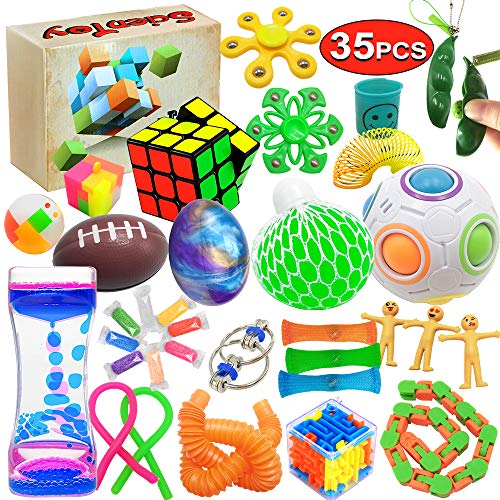
This 35-piece sensory toy assortment provides a broad range of textures and motion to support focus, anxiety reduction, and fine motor exploration. The set includes a rainbow ball, liquid motion timer, maze puzzle, mesh-and-marble fidgets, putties, pop tubes, and more. Constructed from non-toxic ABS materials and designed to meet safety standards, the toys are suitable for classroom use or home play. Different textures offer tactile feedback, while the varied shapes encourage repetitive, soothing actions that can help kids regulate sensory input during transitions or stressful moments.
Playbees Light-Up Transparent Car Toy

This sensory car toy offers a bumper-and-go driving action that promotes hand-eye coordination and spatial awareness. The transparent body reveals spinning gears, providing visual curiosity about mechanical movement. The built-in LED lights and accompanying music create a multisensory experience designed to captivate attention and extend play sessions. The combination of light, motion, and sound can be particularly engaging for autistic children who benefit from consistent, predictable sensory cues.
LearnToy Busy Board
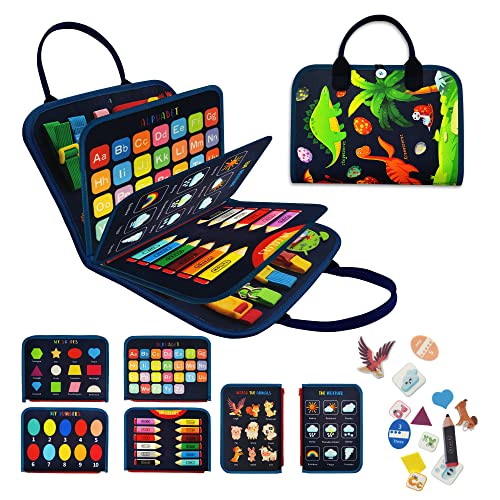
The LearnToy Busy Board is a portable, Montessori-inspired activity book designed for toddlers 3 to 5 years old. It emphasizes fine motor development, concentration, and collaborative skills through a variety of textures and simple tasks. The board’s flexible zipper connections and multiple pages allow kids to practice threading, matching, and problem-solving. Its travel-friendly design makes it suitable for car rides, flights, or quiet corners at school, promoting sustained, independent engagement with minimal frustration.
Yetonamr Montessori Toys For 1 2 3 Years Old

This wooden sorting and stacking puzzle contains 20 pieces across colors and geometric shapes. Built to support color recognition, shape differentiation, and early geometry, the set encourages trial-and-error problem solving and hand-eye coordination. The wooden pieces are chunky for easy grasping, with smooth edges and non-toxic finishes. The design aligns with Montessori principles by encouraging independent exploration and purposeful play, ideal for developing concentration and spatial awareness in toddlers aged 1-3, and adaptable for older preschoolers as well.
Buying Guide: Key Purchase Considerations For Autistic Toddlers
- Sensory balance: Look for toys that offer visual, tactile, and auditory input without being overwhelming. Adjustable volume, switchable sound, and soft textures can help tailor experiences to a child’s needs.
- Language and communication support: Tools with clear, simple cues—such as labeled images, pronounceable words, or simple prompts—can reinforce vocabulary, naming, and verbal imitation opportunities.
- Motor skill development: Items that require reach, grasp, squeeze, or stack promote fine motor control and hand strength. Montessori-inspired designs often emphasize deliberate, self-paced activities.
- Predictability and routine: Repetitive actions and consistent feedback aid in reducing anxiety. Toys that reward repetitive attempts with visible progress can be particularly comforting.
- Safety and materials: Prioritize non-toxic materials, rounded edges, and durable construction suitable for rough handling. Check for ASTM/EN71 or equivalent toy-safety certifications where possible.
- Portability and setup: For families traveling or motor-limited play spaces, choose compact, lightweight options with easy setup and cleanup to encourage frequent use.
- Caregiver involvement: Some toys work best with guided play, while others promote independent exploration. Consider a mix to support both structured learning and solo play.
- Age appropriateness: While marketed for ages 3-5, ensure the difficulty level aligns with the child’s current abilities and sensory profile to avoid overstimulation.