Parents and educators seek engaging tools that support early language skills. The following selections focus on vocabulary expansion, pronunciation practice, comprehension, and independent learning through play. Each choice blends clear audio, visual cues, and interactive activities designed for toddlers and young children. Read on to discover five evidence-informed options that can help nurture communication, storytelling, and cognitive development in everyday learning moments.
| Product | Brand | Key Benefit |
|---|---|---|
| Airbition Talking Flash Cards for Toddlers (224 Words) | Airbition | Voice-enabled, Montessori-inspired vocabulary builder for autism and speech therapy contexts |
| LeapFrog Learning Friends 100 Words Book | LeapFrog | 100+ age-appropriate words with interactive sound effects and songs |
| Learning Toy for Toddlers: Farm Train | Play-Act | Color and number concepts with open-ended imaginative play |
| Imitation Book: Interactive Talk Book | Twin Cities Speech Therapy Publishing | Speech therapy-aligned practice with structured prompts for talking |
| Zeoddler Alphabet Puzzles | Zeoddler | Wooden letter recognition supports early literacy and fine motor skills |
Airbition Talking Flash Cards (224 Words) for Toddlers

Airbition’s Talking Flash Cards deliver 224 vivid illustrations paired with sounds to reinforce vocabulary. This Montessori-aligned setup covers animals, vehicles, foods, and more, supporting quick association between words and images. Designed as a versatile tool for speech therapy and autism play, the device reads content in a clear American accent and includes a repeat function and five-level volume control. A simple on/off switch and easy card insertion make it approachable for toddlers to use independently or with adult guidance. This format helps children practice pronunciation, expand word banks, and build cognitive connections through multisensory cues.
The Montessori emphasis on self-directed learning aligns with language development goals: learners activate content, receive immediate feedback, and can revisit words at their own pace. The sound-image pairing is particularly valuable for children who benefit from auditory and visual reinforcement, providing a stable routine for repeated exposure to new terms and sentence structures.
LeapFrog Learning Friends 100 Words Book
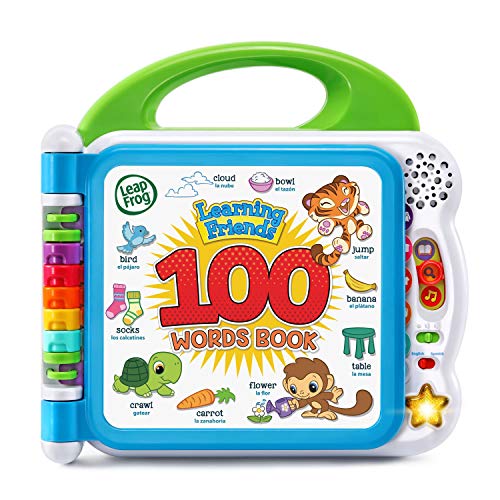
The LeapFrog Learning Friends 100 Words Book introduces more than 100 words across categories like pets, colors, foods, opposites, and activities. Interactive pages respond to touch with words, sounds, and a friendly theme song, encouraging kids to explore language through playful prompts. The three Learning Friends—Turtle, Tiger, and Monkey—guide exploration, making vocabulary acquisition engaging and predictable. The product is designed to foster word recognition, listening skills, and early decoding of speech sounds in a fun, story-like format.
Key language development elements include context-rich word exposure and auditory reinforcement. By tapping pages to reveal new terms and phrases, children practice listening, fluent word retrieval, and basic sentence ideas, while caregivers can model sentence structures and expand conversations beyond isolated words. This approach supports both receptive and expressive language milestones in a non-intimidating, interactive environment.
Learning Toy for Toddlers: Farm Train

This Montessori-inspired learning toy blends color and number concepts with open-ended play. The vibrant sorting activity includes 10 numbered barns and four colorful wagon carriages pulled by a locomotive, inviting children to engage in loading, unloading, stacking, and sorting. An open train with a detachable roof adds a tactile dimension, encouraging pretend play and narrative development as children describe what they are doing and naming characters or objects involved. Language learning emerges as kids articulate actions, colors, quantities, and sequences.
By combining sorting challenges with story-driven play, this toy supports expressive language as children narrate steps, compare quantities, and describe relationships between items. The physical manipulation of pieces strengthens fine motor planning, which complements language practice by providing concrete opportunities to discuss spatial terms, quantities, and cause-and-effect phrases during play sessions.
Imitation Book: Interactive Talk Book

The Imitation Book from Twin Cities Speech Therapy Publishing provides a structured language practice framework tailored for toddlers and early learners. It emphasizes talking skills, supporting late talkers with targeted prompts and activities. The book format fosters repetition and routine, essential for phonological awareness, word retrieval, and speech production. Clinically inspired content helps caregivers engage children in turn-taking, listening, and echoing phrases in meaningful contexts.
Structured imitation tasks encourage children to mimic sounds, words, and short phrases, which can boost confidence in verbal expression. The guide-like approach supports adults in delivering consistent language models, enabling practice across daily routines and play periods. This resource can complement therapy goals by reinforcing vocabulary and sentence structure in a natural, conversational manner.
Zeoddler Alphabet Puzzles

Zeoddler Alphabet Puzzles offer 26 uppercase letters crafted from natural wood, designed for preschoolers to recognize letters while building fine motor skills. These wooden puzzles support early literacy by matching letters to shapes and sounds, making it easier for children to recall letter names and begin letter-sound associations. The durable, child-friendly design supports repeated practice, a key element in language development as kids begin forming letter-word connections and simple spellings.
The Montessori-like design encourages independent exploration, letting children manipulate pieces and experiment with letter order. As children complete each puzzle, caregivers have an opportunity to introduce vocabulary related to letters, sounds, and common words that begin with each letter. This activity aligns with early literacy standards and can serve as a foundational step toward decoding skills and phonemic awareness.
Buying Guide: Key Purchase Considerations And Comparisons
When selecting toys to support language development, consider how each option aligns with a child’s current level and language goals. The following factors help compare choices across categories such as vocabulary breadth, phonemic awareness, comprehension, and interactive engagement.
- Word-rich content: Choose tools that cover a wide range of categories—animals, foods, colors, numbers, transportation, and everyday actions—to maximize exposure to new vocabulary and sentence frames.
- Auditory clarity and pronunciation: Look for products with clear, standard American pronunciation and consistent voice quality to model accurate speech sounds for young listeners.
- Multisensory learning: Devices that combine images, sounds, and touch tend to reinforce memory and word retention, supporting both receptive and expressive language.
- Independent vs. guided use: Some toys enable solo exploration, while others work best with caregiver guidance. A mix supports autonomy and interactive language practice.
- Age-appropriateness and safety: Ensure materials suit the child’s age, abilities, and safety needs. Wooden puzzles and chunky cards are often durable and easy to handle for small hands.
- Language targets: Identify whether the goal is vocabulary expansion, pronunciation practice, storytelling, or following simple instructions, and select tools designed to address those areas.
In practice, combining a repertoire of products—such as a vocabulary‑rich flash card system, an interactive word book, a tactile puzzle set, and a structured imitation book—offers a well-rounded approach. This mix supports diverse language outcomes, from naming and describing to listening comprehension and conversational turn-taking. For caregivers, pairing these tools with daily routines (mealtimes, storytime, playtime) can maximize opportunities for language modeling, repetition, and meaningful conversation.