Kids can explore weather science through engaging, hands-on toys that make meteorology fun and educational. This guide highlights five top picks that blend play with real scientific concepts—from tornado simulations to weather stations. Each product helps children observe weather patterns, measure data, and imagine careers in science while staying safe and imaginative at home or in the classroom.
| Product | Brand | Key Feature |
|---|---|---|
| Discovery Tornado Lab | Discovery | 5-speed tornado control with storm debris |
| Thames & Kosmos Weather & Climate Lab | Thames & Kosmos | 5-in-1 weather station with wind vane and rain gauge |
| SMARTLAB Storm Watcher | SMARTLAB | 18 experiments and weather instruments |
| Hand2mind Explore The Weather Counters | hand2mind | Weather-themed counting and sorting |
| TEDCO-Pet Tornado | TEDCO | Pocket tornado demonstration and educational info |
The selections cover interactive experiments, measurement tools, and role-play costumes to inspire curiosity about weather. Each item is suitable for children around age 6 and up, supporting STEM learning through observation, comparison, and data collection.
Discovery Tornado Lab: Eye-Catching Weather Science
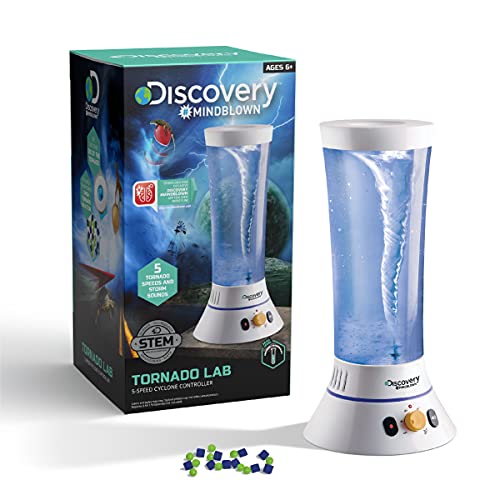
The Discovery Tornado Lab offers a compact hands-on experience for studying tornado mechanics and meteorology at home. Kids can create and observe tornadoes, using reusable storm debris to visualize destructive force while exploring atmospheric physics. Five preset intensity speeds let children control the storm, and realistic audio enhances the experiential learning. This kit is designed for children six and older, encouraging safe experimentation and weather-themed exploration in a classroom or family setting.
Key educational angles include modeling tornado formation, comparing different storm intensities, and linking observed phenomena to real-world weather science. The kit’s build and components promote inquiry, hypothesis testing, and documentation of outcomes, aligning with elementary science standards and inquiry-based learning.
Yewong Meteorologist Costume Set: Weather Role Play

The Yewong Weather Man costume set offers a playful way to spark imagination about weather careers. Included items—necktie, fake microphone prop, glasses, weather forecast chart, and maple leaves—facilitate role-play and storytelling around weather forecasting. While not a scientific instrument, the set supports language development, vocabulary expansion, and classroom skits about meteorology. The weather board chart is a durable educational prop suitable for hands-on activities with younger children and early readers.
Thames & Kosmos Weather & Climate Lab

This 5-in-1 weather station from Thames & Kosmos provides a compact platform to investigate weather phenomena and broader climate patterns. The kit includes a weather vane, compass, rain gauge, anemometer, and thermometer, with a sturdy stake for outdoor use. Real-time measurements encourage children to observe, compare, and record data across different days and conditions. The design emphasizes portability and durability, making it suitable for both at-home science corners and school science fairs.
Educational value centers on data collection, pattern recognition, and understanding how each instrument contributes to a weather snapshot. The weather station’s outdoor capability supports experiments with sunlight, wind, precipitation, and temperature. The versatility helps align activities with standards in earth science and environmental studies.
SMARTLAB Storm Watcher Weather Lab
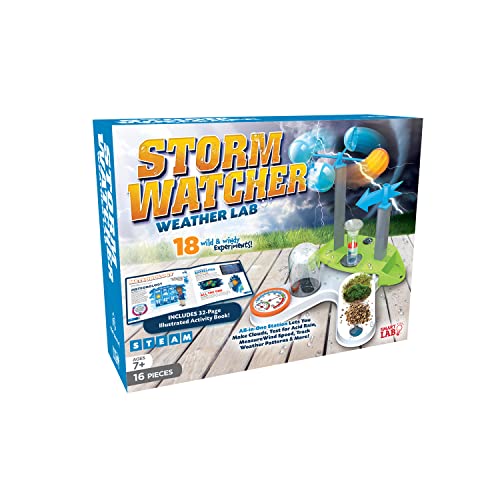
The SMARTLAB Storm Watcher Weather Lab offers a comprehensive set of 18 experiments with a built-in weather station. The collection includes a weather vane, rain gauge, anemometer, thermometer with hygrometer, and a 32-page illustrated book detailing extreme weather concepts. Activities cover cloud identification, barometer creation, ocean acidification, and even tornado scale concepts. This kit supports indoor or outdoor exploration and helps translate abstract weather ideas into tangible experiments and observations.
Hand2mind Weather Counters: Early Math Meets Meteorology

Hand2mind’s Explore The Weather Counters blends math manipulatives with weather-themed shapes to support counting, sorting, and patterning. With sun, cloud, lightning, rain, wind, and snow pieces in multiple colors, children practice early math skills while learning weather elements. The counters come in 100% recycled plastic, aligning with eco-friendly classroom material goals. This set is ideal for preschool and early elementary learners focusing on foundational math and science connections in a hands-on way.
Buying Guide
- Educational goals: Choose kits that balance hands-on experiments with measurable outcomes, such as data collection or observable phenomena.
- Age appropriateness: Check recommended ages to ensure activities match development and safety considerations.
- Indoor vs. outdoor use: Some stations are designed for outdoor experiments, while others suit indoor classroom or home settings.
- Instrument realism: Realistic tools (anemometers, rain gauges) foster authentic data collection and help bridge to real-world weather science.
- Storage and durability: Consider whether components include storage solutions and whether materials are durable for repeated use.
- Curriculum fit: Align products with science standards, inquiry-based learning, and cross-disciplinary activities (math, literacy, geography).
- Expansion potential: Look for modular kits or compatible accessories that enable growing complexity as a child’s interest deepens.
- Safety and materials: Preference for non-toxic, child-safe materials; closely examine small parts for younger kids.
Across these options, parents and educators can select weather-themed toys that suit different learning styles—from tactile measurement and data logging to imaginative role-play and structured science experiments. The right combination supports curiosity, critical thinking, and foundational STEM skills in engaging, age-appropriate ways.